eISSN: 2093-8462 http://jesk.or.kr
Open Access, Peer-reviewed

eISSN: 2093-8462 http://jesk.or.kr
Open Access, Peer-reviewed
Seunghee Hong
, Byungchan Min
10.5143/JESK.2026.45.4.253 Epub 2026 September 01
Abstract
Objective: This study examines digital transformation trends in ergonomics with a focus on the transition from human-state monitoring to human state-based resource allocation and proposes an integrated framework.
Background: Digital transformation has expanded ergonomics from physical-fit design to data-driven, human-state adaptive systems. However, the connection between human-state evidence and resource-allocation decisions remains underdeveloped.
Method: A horizon scanning and strict code-based review were conducted using IEA, ESK/JESK, and JES/JSK records from 2019 to 2025. A total of 3,770 raw records were identified. After duplicate removal, period filtering, eligibility screening, and manual-review separation, 1,317 strict-coded records were included.
Results: Human State Sensing was the largest substantive category excluding the umbrella application-domain category (B, n=343, 26.04%). Cognitive Workload and Attention (C, n=171, 12.98%) and Fatigue, Stress, and Recovery (D, n=130, 9.87%) followed. Resource Allocation Decisions (F, n=21, 1.59%) and Governance and Ethics (G, n=29, 2.20%) remained limited.
Conclusion: The findings identify an evidence-to-decision gap: human-state sensing and application-domain studies are more prevalent than studies that translate state information into allocation decisions and governance mechanisms. A five-step framework consisting of Sensing, Modeling, Allocation, Feedback, and Governance is proposed.
Application: The framework can guide fatigue management, adaptive task assignment, worker-participatory feedback, and governance design in industrial, educational, healthcare, and transportation settings.
Keywords
Digital twin Human state sensing Resource allocation Fatigue management Horizon scanning
디지털 전환은 인간공학의 연구 초점을 물리적 적합성 중심 설계에서 인간 상태를 반영하는 데이터 기반 설계로 확장하였다. 산업 현장, 교육 환경, 의료 및 교통 시스템은 웨어러블 센서, 생체신호, 인공지능, 디지털 트윈, 데이터 기반 의사결정 기술을 활용하여 작업자의 생리적 · 인지적 · 행동적 상태를 운영에 반영하는 방향으로 발전하고 있다(Modoni and Sacco, 2023; Asad et al., 2023; Krupas et al., 2024; Park et al., 2023).
휴먼 디지털 트윈(Human Digital Twin, HDT)은 인간의 신체, 행동, 인지, 피로, 회복 상태를 디지털 모델과 연결하여 상태 추정, 위험 예측, 개입 설계를 지원하는 접근이다. 최근 연구는 HDT를 정적 디지털 휴먼 모델링의 확장이 아니라, 물리적 인간, 가상 인간, 그리고 두 영역을 연결하는 데이터 · 모델 링크가 결합된 인간 중심 의사결정 체계로 정리한다(He et al., 2024; Gaffinet et al., 2025; Bucci et al., 2025).
기존 인간공학 연구는 인간 상태 측정과 모델링을 중심으로 빠르게 축적되었다. 정신작업부하 연구에서도 HRV, EEG, EDA, eye movement와 같은 생리 · 행동 지표를 맥락에 맞게 결합해야 한다는 점이 반복적으로 지적되어 왔다(Charles and Nixon, 2019). 반면 측정된 상태 정보를 작업 배정, 휴식 배정, 인력 배치, 공간 배치, 위험노출 조정과 같은 실제 운영 의사결정으로 전환하는 연구는 상대적으로 제한적이다(Kubo et al., 2022; Lee, 2017).
본 연구의 목적은 2019년부터 2025년까지 IEA, JES/JSK, ESK/JESK 자료를 대상으로 인간 상태 기반 자원배분 인간공학의 연구지형을 비교하고, A-H 코드북 기반의 정량 분석을 통해 연구 공백을 식별하며, Sensing-Modeling-Allocation-Feedback-Governance로 이어지는 통합 프레임워크를 제안하는 데 있다. 본 연구의 기여는 세 가지다. 첫째, 국제 · 국내 · 일본 인간공학 문헌을 동일 기간 안에서 비교하여 디지털 전환의 주제 분포를 정량화한다. 둘째, 상태 센싱 · 인지부하 · 피로 연구와 자원배분 · 거버넌스 연구 사이의 구조적 불균형을 제시한다. 셋째, HDT 기반 인간 상태 자원배분 인간공학을 센싱 기술의 집합이 아니라 절차적 의사결정 프레임으로 재정의한다.
2.1 Study design and source inventory
본 연구는 2019년부터 2025년까지의 인간공학 디지털 전환 동향을 식별하기 위해 horizon scanning 절차를 적용하였다. Horizon scanning은 특정 연구 분야에서 새롭게 부상하는 이슈와 연구 공백을 조기에 식별하는 탐색적 검토 접근이며, 본 연구에서는 인간공학 문헌의 디지털 전환 양상을 비교하기 위한 자료 탐색 틀로 사용하였다(Sutherland and Woodroof, 2009).
분석 대상은 IEA, ESK/JESK, JES/JSK의 공식 문헌, 도서관 검색 DB export, J-STAGE 서지자료, 학술대회 프로시딩 PDF에서 구축하였다. IEA와 ESK/JESK 자료는 한밭대학교 도서관 검색 결과를 기반으로 정리하였고, JES/JSK 자료는 일본 학회 홈페이지와 J-STAGE 연결 자료 및 프로시딩 PDF를 통해 수집하였다.
자료의 유형이 기관별로 동일하지 않다는 점을 고려하여, 본 연구는 문헌 유형을 학술대회 발표, 학회지 논문, 프로시딩, 프로그램/메타데이터, 기술위원회 및 공식 활동 자료로 구분하였다. 기관 간 비교는 완전 동일 모집단 비교가 아니라, 동일 기간 내 공식 인간공학 문헌에서 확인 가능한 주제 분포의 비교로 한정하였다.
2.2 Screening and exclusion procedure
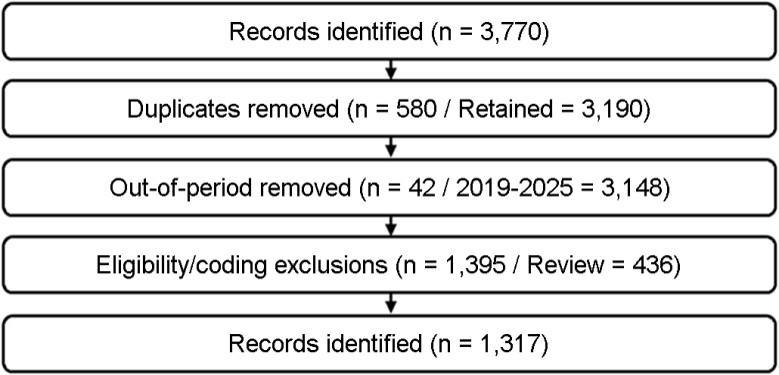
총 3,770건의 원자료를 식별하였다. 동일 기관, 동일 연도, 정규화된 제목 기준으로 중복 580건을 제거하여 3,190건을 남겼다. 기간 외 자료 42건을 제외한 뒤 기간 적합 자료 3,148건을 적격성 검토 대상으로 삼았다. 비연구성 자료, 코드 판정 불가 자료, 추출 품질 검토 자료를 분리하였다. 최종 빈도분석에는 엄격 코딩 기준을 충족한 1,317건만 포함하였다(Table 1, Figure 1).
|
Society |
Main source |
Raw |
Deduped |
2019-2025 |
Included |
Manual |
Excluded |
|
ESK/JESK |
Hanbat Library DB export; ESK/JESK |
2,158 |
1,849 |
1,842 |
894 |
3631 |
901 |
|
IEA |
Hanbat Library DB export; IEA |
577 |
335 |
300 |
169 |
22 |
386 |
|
JES/JSK |
J-STAGE journal metadata; |
1,035 |
1,006 |
1,006 |
254 |
51 |
730 |
|
Total |
All sources |
3,770 |
3,190 |
3,148 |
1,317 |
436 |
2,017 |
2.3 Codebook and strict coding protocol
수집 자료는 연구목적, 제목, 초록, 주제어, 세션명을 기준으로 8개 범주(A-H)에 따라 코딩하였다(Table 2). 각 자료에는 하나의 주코드를 부여하였다. 다중 코딩으로 인한 중복 카운팅 문제를 방지하기 위해 부코드를 기록하였으나, 빈도분석과 기관 간 비교에는 주코드 기준 건수만 사용하였다.
|
Code |
Category |
Operational definition |
Inclusion and boundary
rule |
|
A |
Digital Twin |
Studies representing the physical, behavioral, |
- Inclusion:
HDT, DHM, digital human, digital twin, virtual human, musculoskeletal/human
model - Boundary:
Assign A when human state or human behavior modeling is central. |
|
B |
Human State Sensing |
Studies measuring or estimating human states using sensors, logs,
or biosignals. |
- Inclusion: HRV, EEG,
EDA, EMG, eye tracking, motion capture, wearable, biosignal, posture
estimation - Boundary: Assign B
when the measurement technology is central. Add D as a secondary code when
the measured outcome is fatigue or stress. |
|
C |
Cognitive Workload & Attention |
Studies evaluating cognitive load, attention, situation awareness,
or mental workload. |
- Inclusion: cognitive
workload, attention, vigilance, NASA-TLX, situation awareness - Boundary: Assign C
when cognitive state evaluation is the primary outcome. |
|
D |
Fatigue, Stress |
Studies treating fatigue, stress, recovery, sleep, |
- Inclusion: fatigue,
stress, sleep, recovery, burnout, shift work, rest break - Boundary: Assign D
when fatigue or stress |
|
E |
Adaptive/ |
Studies in which interfaces, environments, equipment, training
difficulty, robot motion, |
- Inclusion: adaptive
UI/system/training, bio-adaptive, personalization, feedback control,
closed-loop - Boundary: Assign E
when a system response or adjustment logic is present. |
|
F |
Resource |
Studies connecting human-state information |
- Inclusion: task
allocation, scheduling, staffing, work assignment, rest allocation,
optimization - Boundary: Assign F
preferentially when an allocation decision is explicitly specified. |
|
G |
Governance |
Studies addressing privacy, consent, |
- Inclusion: privacy,
consent, surveillance, fairness, accountability, governance, explainability - Boundary: Assign G
when institutional, ethical, or accountability criteria are addressed. |
|
H |
Application |
Studies specifying application domains such |
- Inclusion:
manufacturing, healthcare, mobility, education, office, public, construction,
logistics, safety domain - Boundary: Use H as a
secondary code whenever possible. If no A-G code applies and the application
domain is clear, assign |
코딩은 조작적 정의, 포함 기준, 제외 기준, 경계 규칙을 충족한 경우에만 최종 strict-coded set에 포함하였다. A-G 판정 근거가 부족하고 응용 맥락만 확인되는 H-only 항목, 제목 추출 불확실 항목은 Manual Review 목록으로 분리하였고, 본문 정량 결과에는 포함하지 않았다. 본 연구는 복수 코더 기반 신뢰도 수치를 산출하지 않았으므로, 코딩 일관성은 코드북과 screening log의 투명한 제시를 통해 보완하였다.
2.4 Quantitative interpretation criteria
Strong, Moderate, Limited 평가는 각 기관의 최종 strict-coded 자료 내 주코드 비율을 기준으로 부여하였다. Strong은 기관 내 비율 20% 이상, Moderate는 5% 이상 20% 미만, Limited는 5% 미만으로 정의하였다. 이 기준은 기관별 주제 집중도를 설명하기 위한 기술적 기준이며, 통계적 우열 판정 기준으로 사용하지 않았다.
A-H 전체 분포의 차이는 카이제곱 적합도 검정으로 확인하였다. 다만 이 검정의 기대빈도는 이론적 분포가 아니라 균등기대분포(equal baseline)에 기초한 기술적 기준이다. 전체 검정이 유의한 경우 표준화잔차를 확인하고, Bonferroni 보정을 적용하여 과대표집 및 과소표집 코드를 보수적으로 해석하였다(Sharpe, 2015; MacDonald and Gardner, 2000).
3.1 Final corpus composition
최종 strict-coded 분석 자료는 1,317건이다. 기관별로 ESK/JESK 894건, IEA 169건, JES/JSK 254건이 포함되었다. ESK/JESK는 국내 학술대회 및 학회지 메타데이터가 많아 원자료와 최종 포함 건수가 가장 컸다. JES/JSK는 학회지 및 프로시딩 PDF 기반 자료가 결합되었고, IEA는 국제대회 및 공식 활동 중심의 자료로 구성되었다. 따라서 기관 간 비교는 동일한 수집밀도와 문헌 유형을 가진 세 모집단의 직접 비교가 아니라, 동일 기간 내 공식 인간공학 문헌에서 확인 가능한 주제 분포 비교로 해석하였다.
3.2 Distribution by A-H primary code
B 인간 상태 센싱은 343건(26.04%)으로 A-G 코드 중 가장 큰 비중을 차지하였다(Table 3, Figure 2). C 인지부하 · 주의는 171건(12.98%), D 피로 · 스트레스 · 회복은 130건(9.87%)이었다. H 응용 도메인은 540건(41.00%)으로 가장 높았다.
|
Code |
Category |
n |
Share (%) |
|
A |
Digital Twin & Human Modeling |
50 |
3.80 |
|
B |
Human State Sensing |
343 |
26.04 |
|
C |
Cognitive Workload & Attention |
171 |
12.98 |
|
D |
Fatigue, Stress & Recovery |
130 |
9.87 |
|
E |
Adaptive/Bio-adaptive Systems |
33 |
2.51 |
|
F |
Resource Allocation Decisions |
21 |
1.59 |
|
G |
Governance & Ethics |
29 |
2.20 |
|
H |
Application Domains |
540 |
41.00 |
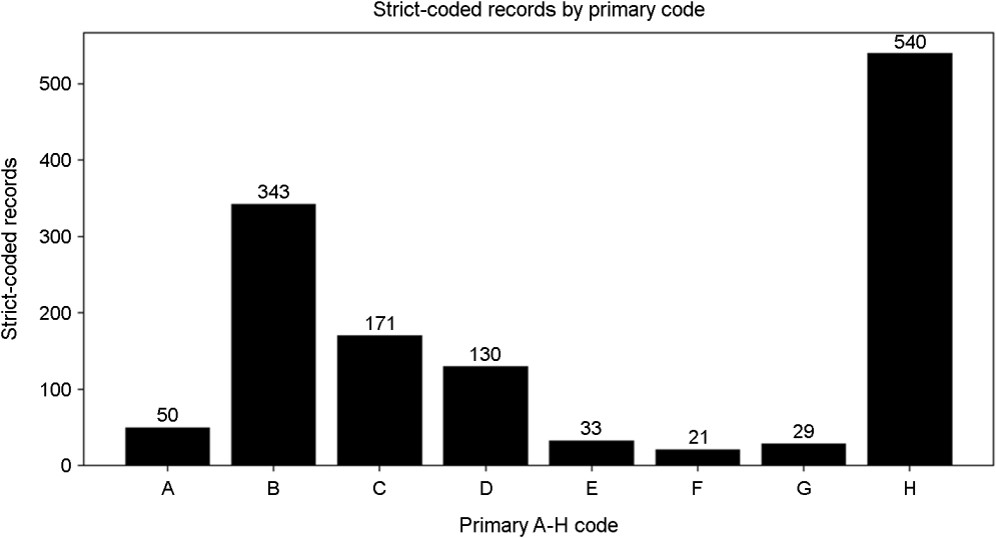
다만 H는 제조, 의료, 교통, 교육, 공공 등 적용 맥락을 포괄하는 상위 범주이므로, 특정 기술 단계의 성숙도를 직접 의미하지는 않는다. 반면 F 자원배분은 21건(1.59%), G 거버넌스 · 윤리는 29건(2.20%)에 그쳐 상대적으로 얇은 연구층을 형성하였다.
3.3 Cross-society comparison
세 기관 모두 응용 도메인(H)의 비중이 높았다(Table 4, Figure 3). B 인간 상태 센싱은 ESK/JESK와 JES/JSK에서 Strong, IEA에서 Moderate로 분류되었다. C와 D는 세 기관 모두에서 Moderate 수준을 보였다. A 디지털 트윈 · 휴먼 모델링은 IEA에서 Moderate, ESK/JESK와 JES/JSK에서는 Limited로 나타났다.
|
Code |
Category |
ESK/JESK |
IEA |
JES/JSK |
|
A |
Digital Twin & Human Modeling |
30 (3.4%, Limited) |
19 (11.2%, Moderate) |
1 (0.4%, Limited) |
|
B |
Human State Sensing |
259 (29.0%, Strong) |
29 (17.2%, Moderate) |
55 (21.7%, Strong) |
|
C |
Cognitive Workload & Attention |
134 (15.0%, Moderate) |
20 (11.8%, Moderate) |
17 (6.7%, Moderate) |
|
D |
Fatigue, Stress & Recovery |
78 (8.7%, Moderate) |
20 (11.8%, Moderate) |
32 (12.6%, Moderate) |
|
E |
Adaptive/Bio-adaptive Systems |
16 (1.8%, Limited) |
4 (2.4%, Limited) |
13 (5.1%, Moderate) |
|
F |
Resource Allocation Decisions |
17 (1.9%, Limited) |
1 (0.6%, Limited) |
3 (1.2%, Limited) |
|
G |
Governance & Ethics |
18 (2.0%, Limited) |
2 (1.2%, Limited) |
9 (3.5%, Limited) |
|
H |
Application Domains |
342 (38.3%, Strong) |
74 (43.8%, Strong) |
124 (48.8%, Strong) |
|
Note. Strong ≥20%, Moderate 5~20%, Limited <5 |
||||
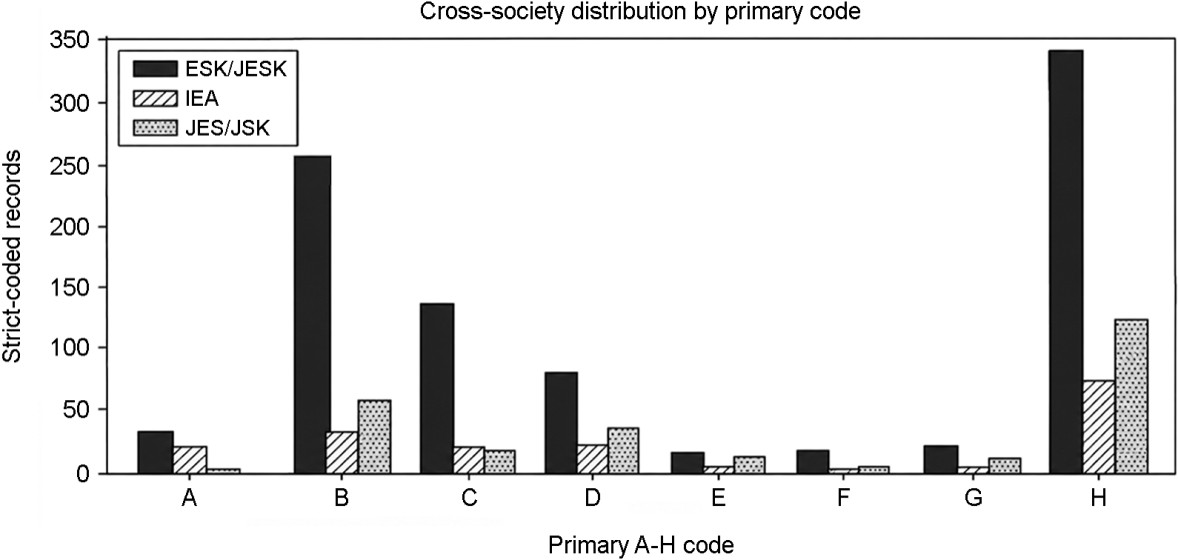
기관 간 비교에서 중요한 사실은 특정 기관의 우열이 아니라 공통 패턴이다. 세 기관 모두에서 B/C/D는 반복적으로 관찰되었고, F/G는 일관되게 낮은 수준에 머물렀다.
3.4 Temporal pattern
연도별 분포는 2021년에 가장 높은 포함 건수(282건)를 보였다. 이후 연도별 자료량은 출처별 수집 범위와 프로시딩 접근성의 차이에 따라 달라졌다. B, C, D는 매년 반복적으로 확인되었으며, F와 G는 전 기간에 걸쳐 낮은 수준을 유지하였다(Table 5).
|
Year |
A |
B |
C |
D |
E |
F |
G |
H |
Total |
|
2019 |
2 |
48 |
18 |
16 |
6 |
1 |
5 |
89 |
185 |
|
2020 |
4 |
41 |
22 |
21 |
6 |
6 |
5 |
74 |
179 |
|
2021 |
17 |
71 |
28 |
28 |
5 |
2 |
6 |
125 |
282 |
|
2022 |
2 |
61 |
32 |
20 |
5 |
4 |
6 |
106 |
236 |
|
2023 |
7 |
36 |
18 |
15 |
1 |
1 |
3 |
42 |
123 |
|
2024 |
11 |
53 |
30 |
18 |
6 |
6 |
2 |
73 |
199 |
|
2025 |
7 |
33 |
23 |
12 |
4 |
1 |
2 |
31 |
113 |
|
Total |
50*** |
343*** |
171 |
130*** |
33*** |
21*** |
29*** |
540*** |
1,317 |
|
Note. Values indicate frequencies. For
descriptive imbalance testing, the pooled A-H distribution was compared with
a uniform expected distribution, χ2(7)=1,478.81, ***p<.001.
Standardized residuals showed that B and H were over-represented, whereas A,
E, F, and G were under-represented after Bonferroni correction (adjusted α=.00625). C
did not differ from the expected frequency. D showed a nominally lower residual (z=-2.70) but did not
exceed the adjusted threshold and was therefore excluded from principal interpretation (Sharpe, 2015; MacDonald and
Gardner, 2000) |
|||||||||
이 결과는 센싱과 응용 맥락이 누적되어 온 반면, 배분과 거버넌스는 시간축 전반에서 얇게 유지되었음을 보여준다. 이하의 논의는 바로 이 분포 차이를 해석의 출발점으로 삼는다.
4.1 From state monitoring to an evidence-to-decision gap
본 연구에서 확인된 핵심은 단순한 빈도 차이가 아니다. 더 중요한 사실은 인간공학 문헌이 상태 측정과 응용 맥락에는 넓게 분포하지만, 그 상태 정보를 작업 · 휴식 · 인력 · 공간 배분과 책임 있는 운영 구조로 전환하는 연구에는 상대적으로 얇게 분포한다는 점이다.
즉, 인간 상태 센싱, 인지부하 평가, 피로 · 회복 측정은 충분한 연구 기반을 형성하였지만, 이 측정값이 실제 운영 의사결정으로 어떻게 반영되어야 하는지에 관한 연구는 아직 제한적이라는 것이다. 본 연구의 중심 명제는 기술 성숙의 선언이 아니라, 상태 측정 evidence와 운영 결정 decision 사이의 간극, 즉 evidence-to-decision gap의 확인이다.
이 구분은 본 연구의 통합 프레임워크가 필요한 이유를 설명한다. Sensing과 Modeling이 인간 상태를 측정하고 해석하는 단계라면, Allocation, Feedback, Governance는 그 상태 정보가 실제 현장 의사결정으로 전환되는 조건을 다룬다. 본 연구는 이 다섯 단계를 하나의 폐루프 구조로 연결함으로써, 인간 상태 데이터가 단순한 관찰 지표에 머물지 않고 인간 중심 운영 판단으로 이어지기 위한 개념적 기반을 제시한다.
4.2 Reframing human state-based resource allocation ergonomics
인간 상태 기반 자원배분 인간공학은 인간의 생리적 · 인지적 · 행동적 상태를 측정한 뒤, 이를 작업 설계와 운영 의사결정에 반영하는 연구 영역으로 정의할 수 있다. 여기서 자원배분은 단순한 인력 배치가 아니다. 작업시간, 휴식시간, 작업순서, 작업강도, 장비 사용, 공간 접근, 위험노출, 경고 방식, 관리자 개입 수준을 모두 포함한다.
이 정의는 인간공학의 전통과 단절되지 않는다. 차이는 데이터의 시간성과 의사결정 구조에 있다. 기존 인간공학이 특정 시점의 부담이나 위험을 평가하는 데 중점을 두었다면, HDT 기반 접근은 상태 데이터의 지속적 갱신, 예측, 의사결정 반영, 피드백을 하나의 폐루프 구조로 통합한다. He et al. (2024)은 디지털 휴먼 모델링에서 HDT로의 전환을, Gaffinet et al. (2025)은 HDT 개념의 혼재를 정리하면서 그 핵심 대상을 '개별 인간'으로 한정하였다. 이 논의는 본 연구의 프레임워크가 조직 전체의 디지털 트윈이 아니라, 인간 상태를 중심으로 한 의사결정 지원 구조에 초점을 두어야 함을 뒷받침한다.
4.3 Integrated framework for HDT-enabled human state-based resource allocation
이 프레임워크는 연구 결과가 축적된 영역(B/C/D, H)과 취약한 영역(A/E/F/G)을 하나의 연구 구조 안에서 연결하는 개념적 통합 안으로 제시하였다(Table 6, Figure 4).
|
Framework |
Related |
Empirical basis in this study |
Interpretation |
|
Sensing |
B, C, D |
B, C, D were repeatedly observed |
Human-state measurement and interpretation constitute the main
empirical base. |
|
Modeling |
A |
A remained limited except for |
HDT/DHM is strategically important but not dominant in strict
primary coding. |
|
Allocation |
F |
F was limited across all societies. |
Translation from state information to task, rest, staffing, and
space decisions remains weak. |
|
Feedback |
E |
E was limited or moderate |
Adaptive response and worker-facing feedback require further
development. |
|
Governance |
G |
G was limited across all societies. |
Privacy, fairness, accountability, and worker participation remain
underdeveloped. |
|
Application |
H |
H was the largest umbrella category. |
Ergonomics remains strongly application-oriented, but H does not
indicate technological maturity. |
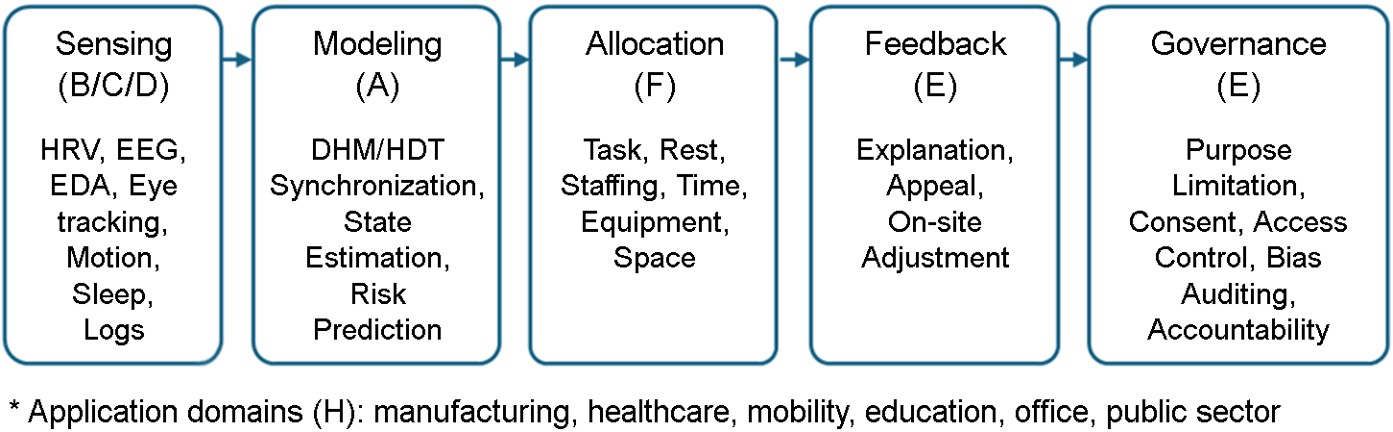
1단계 Sensing은 HRV, EEG, EDA, EMG, eye tracking, motion data, sleep data, work log 등을 통해 인간의 생리적 · 인지적 · 행동적 상태를 측정한다. 핵심은 특정 센서의 우수성을 주장하는 데 있지 않고, 작업 맥락에 적합한 다중 지표 조합과 해석 기준을 설계하는 데 있다(Charles and Nixon, 2019).
2단계 Modeling은 측정된 상태를 디지털 휴먼 모델 또는 휴먼 디지털 트윈과 동기화하는 과정이다. 모델링은 단순 시각화가 아니라 상태 추정, 위험 예측, 작업 적합성 판단을 포함하는 중간 매개 단계다(He et al., 2024).
3단계 Allocation은 예측된 상태를 바탕으로 작업자, 작업시간, 휴식시간, 작업순서, 장비, 공간, 위험노출 수준을 조정하는 단계다. 본 연구에서 낮은 빈도로 나타난 F는 이 단계가 아직 문헌상 취약하다는 점을 보여준다. Kubo et al. (2022)의 교대근무 휴식시간 개입 연구와 Lee (2017)의 원전 작업 연구는 HDT 구현 사례라기보다, 상태 · 위험 정보를 관리 변수로 전환한 인접 사례이다.
4단계 Feedback은 배분 결과를 작업자와 관리자에게 설명하고, 현장 판단과 수정 요청을 반영하는 단계다. 이 단계가 빠지면 시스템은 인간공학적 지원 도구가 아니라 일방적 통제 장치로 전환될 수 있다.
5단계 Governance는 데이터 목적 제한, 최소 수집, 동의, 옵트아웃, 접근권한 통제, 익명화, 편향 점검, 책임 소재를 관리하는 단계다. AI 윤리 지침 연구는 투명성, 공정성, 책임성, 프라이버시를 핵심 원칙으로 정리하였고(Jobin et al., 2019), 알고리즘 윤리 연구는 편향, 불투명성, 책임 소재, 차별 가능성을 핵심 쟁점으로 제시하였다(Mittelstadt et al., 2016). 인간 중심 AI 관점에서도 높은 수준의 자동화와 인간 통제가 함께 설계되어야 신뢰성과 안전성을 확보할 수 있다(Shneiderman, 2020).
정리하면, 이 프레임워크의 핵심은 자동화가 아니라 연결성이다. Sensing은 인간 상태를 측정하고, Modeling은 상태를 해석하며, Allocation은 운영 결정을 조정한다. Feedback은 현장 수용성과 수정 가능성을 보장하고, Governance는 데이터와 알고리즘의 책임성을 관리한다. 이 다섯 단계가 결합될 때 인간 상태 기반 자원배분은 측정 기술의 확장이 아니라 인간 중심 운영체계로 정립될 수 있다.
4.4 Implications for ergonomics research and practice
본 연구의 학술적 함의는 인간공학 연구의 디지털 전환을 센서 기술의 확장으로만 보지 않는 데 있다. 분석 결과는 인간 상태 센싱과 응용 도메인이 강하게 축적된 반면, 자원배분과 거버넌스가 약하다는 점을 보여준다. 이 불균형은 향후 인간공학 연구가 상태 측정 정확도 중심에서 벗어나, 측정된 상태가 실제 의사결정에 어떤 방식으로 반영되는지를 검증해야 함을 의미한다.
본 연구의 학술적 함의는 인간공학의 디지털 전환을 센서 기술의 확장으로만 보지 않는 데 있다. 상태를 얼마나 정밀하게 측정하느냐 못지않게 중요한 문제는, 그 상태 정보가 실제 배분 의사결정과 현장 운영에 어떤 방식으로 연결되는가 이다.
첫째, 후속 연구는 상태 감지 성능만을 보고해서는 안 된다. HRV, EEG, EDA, eye tracking, motion data가 피로, 주의저하, 스트레스, 인지부하를 얼마나 잘 분류하는지에 더해, 그 정보가 작업 배정, 휴식 배정, 위험 회피, 경고 방식, 관리자 개입을 어떻게 바꾸는지까지 검증해야 한다.
둘째, 자원배분 연구는 최적화 목적함수를 인간공학적으로 재정의해야 한다. 전통적 운영 최적화가 생산성, 비용, 처리시간에 집중했다면, 인간 상태 기반 자원배분은 피로 누적, 회복 가능성, 인지적 여유, 위험노출, 개인 간 부담 형평성을 목적함수 또는 제약조건으로 포함해야 한다.
셋째, 거버넌스는 연구의 부록이 아니라 설계 변수다. 생체 · 행동 데이터가 안전과 건강 개선을 넘어 성과 평가, 징계, 차별, 감시에 사용되면 시스템 신뢰는 훼손된다. 따라서 목적 제한, 최소 수집, 설명 가능한 배분 근거, 작업자 참여권, 편향 점검, 감사 가능성은 연구 설계 단계에서 포함되어야 한다.
실무적으로는 산업 안전 영역에서 피로 · 주의저하 · 자세위험 · 협동로봇 근접위험을 감지한 뒤 작업순서와 휴식시간을 조정하는 구조가 요구된다. 의료와 교대근무 환경에서는 회복시간과 업무강도를 함께 고려하는 스케줄링이 필요하다. 교육 영역에서는 인지부하와 몰입도의 변화를 반영하여 과제 난이도와 휴식 타이밍을 조정하는 방향으로 확장될 수 있다.
4.5 Limitations and future research directions
본 연구는 자료의 수집 경로가 서로 다르다는 한계를 갖는다. IEA 자료는 국제대회와 공식 활동 자료 중심이고, ESK/JESK 자료는 국내 학술대회 및 학회지 메타데이터 중심이며, JES/JSK 자료는 J-STAGE 서지자료와 프로시딩 PDF 추출 자료가 결합되어 있다. 이 차이는 기관 간 단순 우열 비교를 제한한다. 본 연구는 이를 고려하여 분석 범위를 동일 기간 내 공식 인간공학 문헌의 주제 분포 비교로 한정하였다.
둘째, 본 연구는 strict-coded corpus를 사용하였다. PDF 추출 품질이 낮거나 코드 판정 근거가 충분하지 않은 자료는 Manual Review로 분리하였다. 따라서 본 연구의 결과는 전체 인간공학 연구의 절대 규모가 아니라, 엄격 기준으로 확인 가능한 주제 분포로 해석해야 한다.
셋째, 독립 코더 기반의 Cohen's kappa 또는 Krippendorff's alpha를 산출하지 않았다. 본 연구는 사전 정의된 코드북, 단계별 screening log, strict-coded corpus를 통해 코딩 모호성을 줄였으나, 정량적 코더 간 신뢰도 검증은 후속 연구에서 보완해야 한다.
후속 연구는 세 방향에서 확장될 필요가 있다. 첫째, A-H 코드 간 관계를 단순 빈도 비교가 아니라 공출현 네트워크, 토픽 모델링, 시계열 회귀로 분석해야 한다. 둘째, F 자원배분과 G 거버넌스를 하위코드로 세분화해야 한다. 셋째, 실제 현장 데이터를 활용해 인간 상태 기반 자원배분이 안전, 회복, 수행도, 수용성, 설명 가능성, 공정성에 미치는 효과를 실증해야 한다.
본 연구는 2019-2025년 IEA, ESK/JESK, JES/JSK 문헌 1,317건을 strict-coded corpus로 구성하고, A-H 주코드 체계를 적용하여 인간공학 연구의 디지털 전환 양상을 비교하였다. 분석 결과는 상태 센싱과 응용 맥락이 두터운 반면, 상태 정보를 실제 자원배분과 거버넌스로 연결하는 연구가 상대적으로 희박하다는 점을 보여주었다.
이 결과는 인간공학이 이미 HDT 기반 자원배분 체계로 전환되었음을 의미하지 않는다. 본 연구의 결론은 오히려 상태 측정 evidence와 운영 의사결정 decision 사이에 구조적 간극이 존재한다는 데 있다. 본 연구가 제안한 Sensing–Modeling–Allocation–Feedback–Governance 프레임워크는 이 간극을 실증적으로 메우기 위한 연구 아젠다이지, 현재의 기술 성숙을 선언하는 모형이 아니다.
향후 인간공학 연구는 상태 감지 정확도, 배분 효과, 현장 수용성, 거버넌스 설계를 함께 검증해야 한다. 이 방향에서 인간 상태 기반 자원배분 인간공학은 디지털 전환 기술을 인간의 안전, 회복, 참여, 공정성으로 연결하는 실천적 연구 영역으로 정립될 수 있다.
References
1. Asad, U., Khan, M., Khalid, A. and Lughmani, W.A., Human-Centric Digital Twins in Industry: A Comprehensive Review of Enabling Technologies and Implementation Strategies, Sensors, 23(8), 3938, 2023. doi:10.3390/s23083938.
Google Scholar
2. Bucci, I., Fani, V. and Bandinelli, R., Towards Human-Centric Manufacturing: Exploring the Role of Human Digital Twins in Industry 5.0, Sustainability, 17(1), 129, 2025. doi:10.3390/su17010129.
Google Scholar
3. Charles, R.L. and Nixon, J., Measuring Mental Workload Using Physiological Measures: A Systematic Review, Applied Ergonomics, 74, 221-232, 2019. doi:10.1016/j.apergo.2018.08.028.
Google Scholar
4. Gaffinet, B., Al Haj Ali, J., Naudet, Y. and Panetto, H., Human Digital Twins: A Systematic Literature Review and Concept Disambiguation for Industry 5.0, Computers in Industry, 166, 104230, 2025. doi:10.1016/j.compind.2024.104230.
Google Scholar
5. He, Q., Li, L., Li, D., Peng, T., Zhang, X., Cai, Y., Zhang, X. and Tang, R., From Digital Human Modeling to Human Digital Twin: Framework and Perspectives in Human Factors, Chinese Journal of Mechanical Engineering, 37, 9, 2024. doi:10.1186/s10033-024-00998-7.
Google Scholar
6. Jobin, A., Ienca, M. and Vayena, E., The Global Landscape of AI Ethics Guidelines, Nature Machine Intelligence, 1, 389-399, 2019. doi:10.1038/s42256-019-0088-2.
Google Scholar
7. Krupas, M., Kajati, E., Liu, C. and Zolotova, I., Towards a Human-Centric Digital Twin for Human-Machine Collaboration: A Review on Enabling Technologies and Methods, Sensors, 24(7), 2232, 2024. doi:10.3390/s24072232.
Google Scholar
8. Kubo, T., Matsumoto, S., Izawa, S., Ikeda, H., Nishimura, Y., Kawakami, S., Tamaki, M. and Masuda, S., Shift-Work Schedule Intervention for Extending Restart Breaks after Consecutive Night Shifts: A Non-randomized Controlled Cross-Over Study, International Journal of Environmental Research and Public Health, 19(22), 15042, 2022. doi:10.3390/ijerph192215042.
Google Scholar
9. Lee, D.H., Managerial Factors Influencing Dose Reduction of the Nozzle Dam Installation and Removal Tasks Inside a Steam Generator Water Chamber, Journal of the Ergonomics Society of Korea, 36(5), 559-568, 2017. doi:10.5143/JESK.2017.36.5.559.
Google Scholar
10. MacDonald, P.L. and Gardner, R.C., Type I Error Rate Comparisons of Post Hoc Procedures for I × J Chi-Square Tables, Educational and Psychological Measurement, 60(5), 735-754, 2000. doi:10.1177/00131640021970871.
Google Scholar
11. Mittelstadt, B.D., Allo, P., Taddeo, M., Wachter, S. and Floridi, L., The Ethics of Algorithms: Mapping the Debate, Big Data & Society, 3(2), 1-21, 2016. doi:10.1177/2053951716679679.
Google Scholar
12. Modoni, G.E. and Sacco, M., A Human Digital-Twin-Based Framework Driving Human Centricity towards Industry 5.0, Sensors, 23(13), 6054, 2023. doi:10.3390/s23136054.
Google Scholar
13. Park, J., Kim, M., Jung, H., Park, C., Cui, X., Lee, S. and You, H., The Advancement Trend of Digital Human Modeling and Simulation, Journal of the Ergonomics Society of Korea, 42(5), 509-521, 2023. doi:10.5143/JESK.2023.42.5.509.
Google Scholar
14. Sharpe, D., Your Chi-Square Test Is Statistically Significant: Now What?, Practical Assessment, Research & Evaluation, 20(8), 1-10, 2015.
Google Scholar
15. Shneiderman, B., Human-Centered Artificial Intelligence: Reliable, Safe & Trustworthy, International Journal of Human-Computer Interaction, 36(6), 495-504, 2020. doi:10.1080/10447318.2020.1741118.
Google Scholar
16. Sutherland, W.J. and Woodroof, H.J., The Need for Environmental Horizon Scanning, Trends in Ecology & Evolution, 24(10), 523-527, 2009. doi:10.1016/j.tree.2009.04.008.
Google Scholar
PIDS App ServiceClick here!
