eISSN: 2093-8462 http://jesk.or.kr
Open Access, Peer-reviewed

eISSN: 2093-8462 http://jesk.or.kr
Open Access, Peer-reviewed
Su Joung Cha
10.5143/JESK.2026.45.4.331 Epub 2026 September 01
Abstract
Objective: This study aimed to identify the major morphological dimensions of seated body shape and classify seated body shape types among male wheelchair users with spinal cord injury to provide anthropometric data for wheelchair-usercentered apparel design.
Background: Conventional apparel sizing systems are primarily based on standing anthropometric measurements and may not sufficiently reflect body shape variations observed in seated postures among wheelchair users.
Method: Data from 246 participants were analyzed using principal component, cluster, variance, and cross-tabulation analyses.
Results: Four morphological dimensions were identified: upper body vertical height, limb length, lower-limb and trunk girth, and upper body breadth and chest depth. These components explained 77.97% of the total variance. Four seated body shape types were classified: long-limbed and trunk girth-developed, narrow and shallow upper-body, slender-girth and broad upper-body, and short-limbed types. Significant differences among the types were observed in upper body height, limb length, trunk and lower-limb girths, upper body breadth, chest depth, and several proportional indices. Age group was significantly associated with body shape type distribution, although the magnitude of the association was small.
Conclusion: The identified seated body shape types highlight the limitations of standing-based sizing and provide a basis for wheelchair-user-centered pattern development.
Application: The findings may serve as fundamental data for developing wheelchairuser- centered sizing systems, ergonomic apparel patterns, and subsequent virtual and physical fit evaluations.
Keywords
Spinal cord injury Wheelchair users Seated body shape Anthropometric characteristics Clothing design
현대사회에서 장애인의 삶의 질 향상과 사회참여 확대에 대한 관심이 높아지면서 장애인의 신체적 특성과 생활환경을 반영한 인간공학적 제품 설계의 중요성이 강조되고 있다. 2024년 말 기준 우리나라 등록장애인은 약 263만 1천 명으로 전체 인구의 5.1%를 차지하며, 이 중 65세 이상 등록장애인의 비율은 55.3%로 나타나 장애 인구의 고령화가 뚜렷하게 진행되고 있다. 또한, 남성 등록장애인은 약 152만 5천 명으로 전체 등록장애인의 58.0%를 차지하여 여성보다 높은 비중을 보였다. 이러한 인구학적 변화는 장애인의 신체 특성과 생활 방식을 고려한 의복, 보조기기 및 생활제품 개발의 필요성을 더욱 높이고 있다(Ministry of Health and Welfare, 2025).
휠체어 사용자는 일상생활의 많은 시간을 착석 자세로 보내기 때문에 의복 착용 시 맞음새, 착탈의 용이성, 복부 압박, 뒤허리 당김 및 허리 부위 말림 등 다양한 불편을 경험할 수 있다(Lamb, 2001; Feng and Hui, 2021). 특히, 척수손상 장애인의 경우 손상 수준과 신체기능에 따라 하지 근위축, 체간 안정성 저하, 체지방 증가 및 자세 비대칭 등이 나타날 수 있으며, 이러한 특성은 착석 자세에서의 신체 형태와 의복 착용 상태에 영향을 미칠 수 있다(Giangregorio and McCartney, 2006; Raguindin et al., 2021). 따라서 기립 자세의 인체치수를 중심으로 개발된 기존 의류 치수체계만으로는 척수손상 휠체어 사용자의 착석 상태에서 나타나는 체형 변이를 충분히 반영하기 어려울 가능성이 있다.
기존 의류 치수체계와 패턴 설계는 주로 기립 자세에서 측정한 가슴둘레, 허리둘레 및 엉덩이둘레 등의 기본 치수를 중심으로 구축되어 왔다(Ashdown, 2007). 그러나 착석 자세에서는 골반과 무릎의 굴곡, 체중 지지 위치 및 근육 사용 방식이 변화함에 따라 복부와 둔부의 형태, 체간의 전후 깊이 및 신체의 공간 점유 특성이 달라질 수 있다(Sprigle and Sonenblum, 2011). 또한, 휠체어 사용자의 제품 및 환경 설계를 위해서는 일반적인 착석 높이와 너비뿐만 아니라 체간 깊이, 복부돌출, 상지 도달거리 및 신체 각 부위의 상대적 비례를 함께 고려할 필요가 있다(Adnan et al., 2019; Paquet and Feathers, 2004). 이러한 점에서 휠체어 사용자의 착석 자세를 기반으로 한 별도의 인체측정 자료와 체형 특성에 관한 연구가 요구된다.
장애인 및 휠체어 사용자를 대상으로 한 기존 연구에서는 의복의 맞음새, 착탈의 편의성, 착석 상태의 쾌적성 및 기능적 구조와 관련된 요구가 주요하게 다루어져 왔다(Feng and Hui, 2021; Rana et al., 2024). 이들 연구는 휠체어 사용자의 의복 착용 불편과 기능적 요구를 규명하였으나, 실제 인체측정 자료를 바탕으로 체형분류를 직접 수행하지는 않았다. 인체측정 분야에서는 다양한 장애 유형의 수동 및 전동 휠체어 사용자를 대상으로 착석 상태의 높이, 너비 및 깊이 치수와 신체의 공간 점유 범위를 분석하여 제품과 환경 설계에 적용하려는 연구가 이루어졌다(Paquet and Feathers, 2004; Adnan et al., 2019). 그러나 이들 연구는 주로 개별 인체치수와 설계 기준을 제시하는 데 초점을 두었으며, 체형을 구성하는 다차원적 형태 요인을 도출하거나 체형 유형을 분류하지 않았다. 또한, 척수손상 장애인을 대상으로 한 연구에서는 근위축, 체지방 분포 및 골격근 감소와 같은 신체조성의 변화가 주로 분석되었다(Giangregorio and McCartney, 2006; Raguindin et al., 2021).
휠체어 사용자의 체형분류 연구에서 Park et al. (2019)은 한국 남성 휠체어 사용자의 인체측정치와 측면 사진을 이용하여 등과 복부 형태를 분석하고 군집분석을 통해 상반신 측면 체형을 세 가지 유형으로 분류하였다. Xing et al. (2024)은 여성 마비 휠체어 사용자의 하반신 인체치수에 주성분분석과 2단계 군집분석을 적용하여 세 가지 하반신 체형과 다섯 가지 치수규격을 제시하였다. 그러나 이러한 연구는 상반신의 측면 윤곽 또는 하반신과 같이 특정 신체 부위와 의복 아이템에 필요한 치수를 중심으로 분석하였다. 이에 본 연구는 척수손상 남성 휠체어 사용자를 대상으로 표준화된 직접측정 절차에 따라 수집된 자료를 활용하고, 체간의 높이 · 너비 · 깊이, 상 · 하지의 길이와 둘레, 상지 도달거리 및 신체 비례를 종합적으로 분석하여 착석 체형을 구성하는 형태적 차원을 탐색하며 이를 기반으로 착석 체형을 유형화한다는 점에서 기존 연구와 차별성을 갖는다.
따라서 본 연구는 척수손상 남성 휠체어 사용자의 착석 인체치수와 형태지수를 분석하여 착석 체형을 구성하는 주요 형태적 차원을 탐색하고, 이를 기반으로 체형 유형을 분류하고자 한다. 또한, 유형별 인체치수 특성과 연령집단에 따른 체형 유형의 분포를 분석하여 척수손상 남성 휠체어 사용자의 착석 체형에 관한 기초자료를 제시하고자 한다. 본 연구의 결과는 향후 휠체어 사용자를 위한 의복 치수체계 및 패턴 설계 연구에서 고려해야 할 주요 인체치수와 체형 변이를 파악하기 위한 기초자료로 활용될 수 있을 것이다.
2.1 Subjects
본 연구는 국가기술표준원이 2024년에 실시한 제8차 한국인 인체치수조사(Size Korea) 자료 중 휠체어 사용 척수손상 장애인 자료를 활용하였다. 연구대상은 만 20세 이상 남성 척수손상 휠체어 사용자 246명이었다. 분석에 사용된 인체측정 항목의 결측 여부를 확인한 결과, 결측자료는 나타나지 않았다. 또한, 각 변수의 최소값과 최대값, 상자도표 및 표준화 점수를 검토하였으며, 표준화 점수의 절댓값이 3.29 이상인 사례를 이상치 후보로 선정하여 원자료의 측정 범위와 변수 간 일관성을 확인하였다. 검토 결과, 일부 이상치 후보는 확인되었으나 실제 측정 가능한 신체치수 범위에 해당하였으며, 측정 또는 입력 오류로 판단되는 사례는 확인되지 않았다. 따라서 제외된 사례 없이 전체 246명의 자료를 최종 분석에 사용하였다.
연령집단은 연령분포와 집단별 표본수를 고려하여 20~39세, 40~59세 및 60~79세의 세 집단으로 구분하였다. 각 연령집단의 대상자 수는 각각 14명(5.7%), 129명(52.4%) 및 103명(41.9%)이었다. 척수손상 수준, 완전 · 불완전 손상 여부, 손상 후 경과기간, 휠체어 사용기간 및 체간 조절능력은 원자료에서 제공되지 않아 분석에 포함하지 못하였다.
2.2 Analysis items and indices
본 연구에서는 척수손상 남성 휠체어 사용자의 착석 체형 특성을 분석하기 위하여 Size Korea 직접측정 자료에서 높이 8항목, 너비 4항목, 두께 2항목, 둘레 4항목 및 길이 7항목을 포함한 총 25개 인체측정 항목을 선정하였다(Table 1). 측정 항목은 착석 상태에서 체간의 수직 높이와 너비 및 깊이, 상 · 하지의 길이와 둘레, 상지의 수평 도달 특성을 파악할 수 있는 항목을 중심으로 구성하였다.
Division |
Anthropometric
measurement item |
Data
processing |
Final
PCA status |
|
Height (8) |
Sitting
height |
Original |
Retained |
|
Sitting
shoulder height |
Original |
Retained |
|
|
Sitting
cervical height |
Original |
Retained |
|
|
Sitting
elbow height (L) |
L/R
averaged |
Retained
as mean |
|
|
Sitting
elbow height (R) |
L/R
averaged |
Retained
as mean |
|
|
Sitting
popliteal height |
Original |
Retained |
|
|
Sitting
eye height |
Original |
Retained |
|
|
Sitting
knee height |
Original |
Retained |
|
|
Width (4) |
Biacromial
breadth |
Original |
Retained |
|
Upper
arm breadth |
Original |
Retained |
|
|
Waist
breadth |
Original |
Excluded |
|
|
Sitting
buttock breadth |
Original |
Excluded |
|
|
Depth (2) |
Chest
depth |
Original |
Retained |
|
Sitting
abdominal depth |
Original |
Excluded |
|
|
Circumference
(4) |
Sitting
mid-thigh circumference |
Original |
Retained |
|
Sitting waist circumference
at |
Original |
Retained |
|
|
Sitting
calf circumference |
Original |
Retained |
|
|
Neck
circumference |
Original |
Retained |
|
|
Length (7) |
Sitting
buttock-popliteal length |
Original |
Retained |
|
Sitting
buttock-knee length |
Original |
Retained |
|
|
Arm
length (L) |
L/R
averaged |
Retained
as mean |
|
|
Arm
length (R) |
L/R
averaged |
Retained
as mean |
|
|
Forearm
length |
Original |
Excluded |
|
|
Forearm
horizontal length (L) |
L/R
averaged |
Excluded
after averaging |
|
|
Forearm
horizontal length (R) |
L/R
averaged |
Excluded
after averaging |
|
|
Total |
25 directly measured items |
22
candidate variables after |
17 variables retained |
|
Note. Sitting elbow height, arm length, and forearm
horizontal length were measured on both sides. Each bilateral pair was
converted into one mean variable before PCA. Of the 22 candidate raw
measurements, waist breadth, sitting buttock breadth, sitting abdominal
depth, forearm length, and mean forearm horizontal length were excluded
according to the communality, component-loading, and cross-loading criteria.
A total of 17 raw measurements were retained in the final PCA. L, left; R,
right; PCA, principal component analysis |
|||
직접측정은 국가기술표준원이 전문가 자문과 산업계 수요조사를 바탕으로 마련한 휠체어 사용 척수장애인 인체측정 프로토콜에 따라 실시되었다. 측정은 조사대상자가 일상적으로 사용하는 휠체어에 착석한 상태에서 진행되었으며, 체중 측정 시에만 의자형 체중계로 이동하였다. 측정도구는 휠체어 사용자의 신체적 특성과 측정 과정에서의 불편을 고려하여 선정되었고, 각 항목은 해당 조사에서 규정한 인체 기준점과 직접측정 방법에 따라 측정되었다.
앉은팔꿈치높이, 팔길이 및 아래팔수평길이는 좌우 양측에서 측정되었다. 좌우 측정치의 차이와 관련성을 검토하기 위하여 대응표본 t 검정과 Pearson 상관분석을 실시한 결과, 세 항목의 좌우 측정치 간 상관계수는 .853~.970으로 높게 나타났다. 앉은팔꿈치높이는 좌우 간 유의한 차이가 나타나지 않았으며, 팔길이와 아래팔수평길이는 통계적으로 유의한 차이를 보였으나 평균차이는 각각 0.26cm와 0.24cm로 작았다. 이에 본 연구가 좌우 비대칭의 평가보다 전반적인 착석 체형의 형태적 차원을 분석하는 데 목적이 있다는 점을 고려하여 양측에서 측정된 6개 항목을 3개의 좌우 평균변수로 변환하였다. 따라서 총 25개의 직접측정 항목은 주성분분석을 위한 22개의 원치수 후보변수로 구성하였으며, 좌우 개별 측정치는 기술통계 결과에 각각 제시하였다.
착석 체형의 상대적 비례 특성을 파악하기 위하여 어깨너비지수(shoulder width index), 허리너비지수(waist width index), 흉부입체지수(chest depth index), 복부돌출지수(abdominal protrusion index), 어깨높이비율지수(shoulder height ratio) 및 허리둘레비율지수(waist circumference ratio)의 6개 형태지수를 산출하였다(Table 2). 어깨너비지수와 허리너비지수는 각각 앉은키에 대한 어깨사이너비와 허리너비의 상대적 비율을 나타내며, 흉부입체지수와 복부돌출지수는 각각 상체와 복부의 전후 방향 입체성을 나타낸다. 어깨높이비율지수는 앉은키에 대한 앉은어깨높이의 상대적 비율을, 허리둘레비율지수는 앉은키에 대한 앉은배꼽수준허리둘레의 상대적 발달 정도를 나타낸다. 모든 형태지수는 두 인체치수의 비율에 100을 곱하여 산출한 무차원 변수로, cm 등의 길이 단위와 구분하여 제시하였다.
|
Division |
Definition |
Formula |
|
Shoulder width index |
An index representing horizontal
upper body development, |
(Biacromial breadth / |
|
Waist width index |
An index representing waist
proportion, indicating the |
(Waist breadth / |
|
Chest depth index |
An index representing thoracic
three-dimensionality, |
(Chest depth / |
|
Abdominal protrusion index |
An index representing abdominal
protrusion, indicating |
(Sitting abdominal depth / |
|
Shoulder height ratio |
An index representing relative
shoulder position, |
(Sitting shoulder height / |
|
Waist circumference ratio |
An index representing trunk
circumference development, |
(Sitting waist circumference |
원치수와 원치수로부터 산출된 형태지수 간의 수학적 중복을 방지하기 위하여 6개의 형태지수는 주성분분석과 군집 형성에 포함하지 않았다. 주성분분석에서는 좌우 평균 처리 후 구성된 22개의 원치수 후보변수를 검토하였으며, 공통성, 주성분적재량 및 교차적재 기준에 따라 허리너비, 앉은엉덩이너비, 앉은배두께, 아래팔길이 및 아래팔수평길이 평균값을 제외하였다. 이에 최종적으로 17개의 원치수를 주성분분석에 사용하였다. 형태지수와 주성분분석에서 제외된 일부 원치수는 군집 형성에 직접 사용하지 않고, 도출된 착석 체형 유형의 상대적 비례 특성을 설명하고 유형 간 차이를 비교하기 위한 보조변수로 활용하였다.
2.3 Analysis methods
수집된 자료는 IBM SPSS Statistics 29.0을 이용하여 분석하였다. 연구대상자의 연령분포와 착석 인체치수 특성을 파악하기 위하여 빈도분석과 기술통계분석을 실시하고, 평균, 표준편차, 최소값 및 최대값을 산출하였다. 연령집단에 따른 착석 인체치수와 형태지수의 차이를 검증하기 위하여 집단 간 일원분산분석(between-subjects one-way analysis of variance)을 실시하였다. Levene의 등분산성 검정 결과 등분산성이 충족된 변수에는 일반 일원분산분석과 Tukey HSD 사후검정을 적용하였으며, 등분산성이 충족되지 않은 변수에는 Welch의 일원분산분석과 Games–Howell 사후검정을 적용하였다. 집단 간 차이의 효과크기는 일반 일원분산분석에서 산출된 집단 간 제곱합을 전체 제곱합으로 나누어 η2를 산출하였다(η2=SSbetween/SStotal). 등분산성이 충족되지 않은 변수의 통계적 유의성과 사후비교는 Welch 검정과 Games–Howell 검정을 기준으로 판단하였으나, η2는 동일한 비교기준을 유지하기 위하여 일반 일원분산분석의 비가중 제곱합을 이용하여 산출하였다. η2의 95% 신뢰구간은 일반 일원분산분석의 F 값과 자유도를 이용하여 비중심 F 분포의 비중심모수(noncentrality parameter)를 역추정한 후 η2 척도로 변환하는 방법으로 산출하였다. 신뢰구간 계산은 Python 3.13.5와 SciPy 1.17.0을 이용하였다. 다수의 변수에 대한 반복검정으로 발생할 수 있는 제1종 오류를 통제하기 위하여 Benjamini–Hochberg 방법을 이용한 false discovery rate 보정을 적용하였다.
착석 체형의 주요 형태적 차원을 축약하기 위하여 좌우 평균 처리 후 구성된 22개의 원치수 후보변수를 표준화하여 주성분분석(principal component analysis)을 실시하였다. 자료의 적합성은 Kaiser–Meyer–Olkin 표본적합도와 Bartlett의 구형성 검정을 이용하여 검토하였다. 주성분 수는 고유값 1.0 이상 기준, scree plot의 굴곡 양상 및 주성분의 해석 가능성을 종합하여 결정하였으며, 주성분의 해석을 명확히 하기 위하여 Kaiser 정규화를 적용한 Varimax 직교회전을 실시하였다. 변수의 최종 포함 여부는 공통성 .40 이상과 최대 주성분적재량 .50 이상을 기준으로 검토하였다. 둘 이상의 주성분에서 .40 이상의 적재량을 보이고, 최대 적재량과 두 번째 적재량의 차이가 .20 미만인 변수는 교차적재 변수로 판단하였다. 기준을 충족하지 못한 변수는 한 번에 하나씩 제거하면서 분석을 반복하였다. 그 결과 허리너비, 앉은엉덩이너비, 앉은배두께, 아래팔길이 및 아래팔수평길이 평균값이 제외되었으며, 최종적으로 17개의 원치수가 분석에 포함되었다. 본 분석은 잠재 요인의 규명보다 군집분석을 위한 차원축소를 목적으로 하였으므로 결과는 '주성분' 또는 '체형의 형태적 차원'으로 표현하였다.
도출된 4개의 주성분점수를 이용하여 착석 체형을 분류하였다. 먼저 제곱 유클리드 거리를 적용한 Ward 방법의 계층적 군집분석을 실시하여 덴드로그램과 군집화 일정표를 검토하고 가능한 군집 수의 범위를 탐색하였다. 다음으로 군집 수를 2개부터 6개까지 각각 지정하여 K-means 군집분석을 실시하였다. 초기 군집중심은 IBM SPSS Statistics의 기본 초기 중심 선택방법을 적용하였으며, 최대 반복횟수는 10회, 수렴기준은 0으로 설정하였다. 각 군집해에 대하여 군집 내 제곱합(within-cluster sum of squares, WCSS), 군집 수 증가에 따른 WCSS의 감소 양상, 평균 silhouette coefficient, 군집별 사례 수 및 주성분점수에 근거한 체형 특성의 해석 가능성을 비교하였다. Elbow criterion은 군집 수 증가에 따른 WCSS 감소폭이 뚜렷하게 완화되는 지점을 기준으로 검토하였으며, 평균 silhouette coefficient는 군집 내 응집도와 군집 간 분리도를 평가하는 보조지표로 활용하였다. 이러한 정량적 지표와 각 군집의 사례 수 및 형태적 해석 가능성을 종합하여 최종 군집 수를 결정하였다. 이후 선정된 네 개 군집을 기준으로 K-means 군집분석을 실시하여 연구대상자를 최종 체형 유형으로 분류하였다.
네 개 군집해의 초기 중심값에 따른 안정성을 검토하기 위하여 사례 순서를 무작위로 변경한 K-means 군집분석을 10회 반복하였다. 반복분석에서 도출된 군집은 최종 군집중심의 형태적 특성을 기준으로 기존 군집해와 대응시킨 후, 전체 사례 중 동일한 군집으로 분류된 사례의 비율을 분류 일치율로 산출하였다.
군집분석에 사용된 주성분점수의 유형 간 차이는 군집분류의 독립적인 타당성을 검증하기 위한 근거가 아니라 각 유형의 상대적 형태 특성을 설명하기 위한 자료로 활용하였다. 군집 형성에 직접 사용하지 않은 형태지수와 개별 인체치수의 유형별 차이는 일원분산분석으로 검토하였다. 등분산성이 충족된 변수에는 Tukey HSD 사후검정을, 등분산성이 충족되지 않은 변수에는 Welch 검정과 Games–Howell 사후검정을 적용하였다. 독립표본이나 임상정보를 이용한 외적 타당성 검증이 불가능하므로, 본 연구에서 도출된 유형은 탐색적 체형분류로 해석하였다.
연령집단에 따른 다수 변수의 반복검정에서 발생할 수 있는 제1종 오류를 통제하기 위하여 Table 4의 p 값에 Benjamini–Hochberg 방법을 이용한 false discovery rate 보정을 적용하였다. 반면, 체형 유형별 비교는 군집별 형태 특성을 기술하기 위한 분석이므로 FDR 보정을 적용하지 않았으며, Table 8의 유의확률은 보정하지 않은 p 값을 기준으로 제시하였다.
3.1 Anthropometric characteristics of seated body
척수손상 남성 휠체어 사용자의 착석 인체치수에 대한 기술통계분석 결과, 대상자의 평균 연령은 55.56세였으며, 평균 체중은 69.74kg이었다. 착석 상태의 높이 항목에서는 앉은키가 평균 83.59cm, 앉은눈높이가 72.27cm, 앉은목뒤높이가 58.91cm, 앉은어깨높이가 52.40cm로 나타났다. 앉은팔꿈치높이는 왼쪽과 오른쪽이 각각 19.78cm와 19.61cm였으며, 앉은오금높이와 앉은무릎높이는 각각 평균 39.90cm와 48.66cm로 나타났다.
둘레 항목에서는 앉은배꼽수준허리둘레가 평균 100.53cm, 앉은넙다리중간둘레가 44.28cm, 앉은장딴지둘레가 30.87cm, 목둘레가 42.67cm로 나타났다. 두께 항목에서는 가슴두께와 앉은배두께가 각각 평균 21.13cm와 26.27cm로 분석되었다.
길이 항목에서는 앉은엉덩이오금수평길이가 평균 46.57cm, 앉은엉덩이무릎수평길이는 55.10cm로 나타났다. 팔길이는 왼쪽과 오른쪽이 각각 55.63cm와 55.88cm였으며, 아래팔수평길이는 왼쪽과 오른쪽이 각각 25.47cm와 25.71cm로 나타났다. 너비 항목에서는 어깨사이너비가 평균 38.61cm, 위팔사이너비가 46.09cm, 허리너비가 31.99cm, 앉은엉덩이너비가 36.94cm로 분석되었다(Table 3).
|
Division |
Min |
Max |
Mean |
S.D. |
Skewness |
Kurtosis |
|
Age |
22 |
77 |
55.56 |
10.07 |
-.635 |
.381 |
|
Weight |
42.50 |
108.50 |
69.74 |
11.82 |
.525 |
.443 |
|
Sitting height |
68.90 |
100.40 |
83.59 |
4.06 |
.161 |
1.335 |
|
Sitting shoulder height |
41.70 |
63.10 |
52.40 |
3.54 |
-.063 |
.137 |
|
Sitting cervical height |
42.70 |
68.70 |
58.91 |
3.73 |
-.244 |
1.099 |
|
Sitting elbow height (L) |
7.20 |
30.4 |
19.78 |
3.48 |
.051 |
.849 |
|
Sitting elbow height (R) |
5.30 |
28.8 |
19.61 |
3.45 |
-.089 |
.788 |
|
Sitting popliteal height |
31.50 |
48.00 |
39.90 |
2.88 |
-.157 |
-.035 |
|
Sitting eye height |
58.50 |
86.50 |
72.27 |
3.97 |
.013 |
.746 |
|
Sitting knee height |
40.10 |
57.20 |
48.66 |
3.19 |
-.049 |
-.255 |
|
Mid-thigh circumference |
31.20 |
64.00 |
44.28 |
6.64 |
.423 |
-.248 |
|
Sitting waist circumference (Omphalion) |
74.70 |
134.30 |
100.53 |
10.42 |
.157 |
.120 |
|
Sitting calf circumference |
21.00 |
45.50 |
30.87 |
4.18 |
.523 |
-.023 |
|
Neck circumference |
34.30 |
53.60 |
42.67 |
3.06 |
.430 |
.624 |
|
Chest depth |
12.5 |
28.3 |
21.13 |
2.78 |
-.237 |
.089 |
|
Sitting abdominal depth |
15.3 |
38.0 |
26.27 |
3.94 |
-.125 |
.113 |
|
Sitting buttock-popliteal length |
36.80 |
55.50 |
46.57 |
3.59 |
-.052 |
-.044 |
|
Sitting buttock-knee length |
43.00 |
67.00 |
55.10 |
3.93 |
-.207 |
.392 |
|
Arm length (L) |
47.80 |
62.50 |
55.63 |
2.79 |
.120 |
-.352 |
|
Arm length (R) |
48.70 |
62.00 |
55.88 |
2.64 |
.141 |
-.401 |
|
Forearm horizontal length (L) |
18.30 |
30.70 |
25.47 |
2.31 |
-.593 |
-.139 |
|
Forearm horizontal length (R) |
17.90 |
30.50 |
25.71 |
2.31 |
-.543 |
-.260 |
|
Biacromial breadth |
31.40 |
47.00 |
38.61 |
2.88 |
.000 |
-.296 |
|
Upper arm breadth |
37.10 |
58.80 |
46.09 |
3.60 |
.161 |
.335 |
|
Waist breadth |
22.10 |
41.30 |
31.99 |
3.75 |
.006 |
-.246 |
|
Sitting buttock breadth |
29.50 |
46.90 |
36.94 |
3.33 |
.283 |
-.124 |
|
Shoulder width index |
34.34 |
56.09 |
46.26 |
3.68 |
-.184 |
-.165 |
|
Waist width index |
25.37 |
50.13 |
38.33 |
4.64 |
.047 |
-.244 |
|
Chest depth index |
36.23 |
73.07 |
54.76 |
6.19 |
-.089 |
.204 |
|
Abdominal protrusion index |
60.73 |
107.90 |
82.07 |
7.62 |
.020 |
.852 |
|
Shoulder height ratio |
56.57 |
68.89 |
62.66 |
2.41 |
.024 |
-.433 |
|
Waist circumference ratio |
89.39 |
153.70 |
120.40 |
12.38 |
.149 |
-.103 |
|
Note. Units are years for age, kg
for weight, and cm for anthropometric measurements. Shape indices are
dimensionless |
||||||
착석 인체치수의 분포 특성을 검토한 결과, 왜도의 절댓값은 .635 이하, 첨도의 절댓값은 1.335 이하로 나타나 심각한 비정규성은 확인되지 않았다. 앉은키와 앉은목뒤높이의 첨도는 각각 1.335와 1.099로 다른 항목보다 상대적으로 높았으나, 전체적인 분포는 후속 통계분석을 수행하는 데 큰 문제가 없는 수준으로 판단하였다.
형태지수에 대한 기술통계분석 결과, 어깨너비지수(shoulder width index)는 평균 46.26, 허리너비지수(waist width index)는 평균 38.33으로 나타났다. 흉부입체지수(chest depth index)는 평균 54.76이었으며, 복부돌출지수(abdominal protrusion index)는 평균 82.07로 분석되었다. 또한, 어깨높이비율지수(shoulder height ratio)는 평균 62.66, 허리둘레비율지수(waist circumference ratio)는 평균 120.40으로 나타났다(Table 3).
형태지수의 분포 특성을 검토한 결과, 왜도의 절댓값은 .184 이하, 첨도의 절댓값은 .852 이하로 나타나 심각한 비정규성은 확인되지 않았다. 복부돌출지수의 첨도는 .852로 다른 형태지수에 비해 상대적으로 높았으나, 후속 통계분석을 수행하는 데 문제가 되는 수준은 아닌 것으로 판단하였다.
연령집단에 따른 착석 인체치수와 형태지수의 차이를 분석한 결과는 <Table 4>와 같다. 다수의 인체측정 항목에 대한 반복검정으로 인한 제1종 오류를 통제하기 위하여 Benjamini–Hochberg 방법에 따른 false discovery rate 보정을 적용하였다. 그 결과, 앉은넙다리중간둘레, 앉은엉덩이오금수평길이, 앉은엉덩이무릎수평길이 및 평균 팔길이에서 연령집단 간 유의한 차이가 확인되었다.
|
Division |
20~39 (n=14) |
40~59 (n=129) |
60~79 (n=103) |
Test |
p |
pFDR |
η2 [95% CI] |
|
Weight |
70.55±12.57 |
71.28±12.59 |
67.70±10.44 |
F=2.705 |
.069 |
.202 |
.022 [.000,
.065] |
|
Sitting height |
82.85±5.72 |
84.06±3.51 |
83.11±4.41 |
F=1.808 |
.166 |
.388 |
.015 [.000,
.053] |
|
Sitting shoulder height |
51.14±4.53 |
52.67±3.30 |
52.22±3.68 |
F=1.406 |
.247 |
.423 |
.011 [.000,
.045] |
|
Sitting cervical height |
57.81±6.06 |
59.11±3.26 |
58.81±3.90 |
W=.459 |
.636 |
.756 |
.007 [.000,
.036] |
|
Sitting elbow height_mean |
17.71±4.88 |
19.82±3.14 |
19.81±3.28 |
F=2.659 |
.072 |
.202 |
.021 [.000,
.064] |
|
Sitting popliteal height |
40.59±3.37 |
40.23±2.81 |
39.40±2.83 |
F=2.822 |
.061 |
.202 |
.023 [.000, .067] |
|
Sitting eye height |
71.61±5.80 |
72.67±3.51 |
71.86±4.20 |
W=1.347 |
.274 |
.426 |
.012 [.000, .047] |
|
Sitting knee height |
49.14±3.62 |
49.10±3.29 |
48.04±2.92 |
F=3.398 |
.035 |
.175 |
.027 [.000, .074] |
|
Mid-thigh circumference |
46.70±6.22A |
45.23±7.01AB |
42.77±5.93B |
F=5.066 |
.007 |
.049* |
.040 [.003, .093] |
|
Sitting waist circumference |
97.65±10.24 |
101.35±11.03 |
99.90±9.59 |
F=1.128 |
.325 |
.463 |
.009 [.000, .040] |
|
Sitting calf circumference |
31.81±5.23 |
31.18±4.07 |
30.35±4.16 |
F=1.516 |
.222 |
.423 |
.012 [.000, .047] |
|
Neck circumference |
43.08±2.09 |
43.09±3.15 |
42.08±2.98 |
F=3.327 |
.038 |
.175 |
.027 [.000, .074] |
|
Chest depth |
20.01±3.51 |
21.10±2.86 |
21.33±2.55 |
F=1.423 |
.243 |
.423 |
.012 [.000, .047] |
|
Sitting abdominal depth |
24.52±4.62 |
26.29±4.17 |
26.48±3.52 |
W=1.142 |
.331 |
.463 |
.009 [.000, .040] |
|
Sitting buttock-popliteal |
47.68±3.38A |
47.19±3.53AB |
45.63±3.51B |
F=6.375 |
.002 |
.019* |
.050 [.007, .108] |
|
Sitting buttock-knee length |
56.20±4.07A |
55.81±3.95AB |
54.06±3.69B |
F=6.540 |
.002 |
.019* |
.051 [.008, .109] |
|
Arm length_mean |
57.21±2.58A |
56.27±2.80A |
54.91±2.29B |
F=10.341 |
<.001 |
.001** |
.078 [.022, .144] |
|
Forearm horizontal |
25.13±2.71 |
25.72±2.42 |
25.50±2.08 |
F=.557 |
.574 |
.730 |
.005 [.000, .030] |
|
Biacromial breadth |
38.78±2.97 |
38.75±3.06 |
38.41±2.65 |
F=.435 |
.648 |
.756 |
.004 [.000, .027] |
|
Upper arm breadth |
46.28±4.59 |
46.47±3.64 |
45.60±3.38 |
F=1.703 |
.184 |
.397 |
.014 [.000, .051] |
|
Waist breadth |
30.97±4.37 |
32.17±3.93 |
31.92±3.43 |
F=.677 |
.509 |
.679 |
.006 [.000, .033] |
|
Sitting buttock breadth |
36.69±4.22 |
37.01±3.54 |
36.89±2.94 |
W=.063 |
.939 |
.939 |
.001 [.000, .013] |
|
Shoulder width index |
46.93±3.80 |
46.16±3.84 |
46.30±3.49 |
F=.281 |
.755 |
.799 |
.002 [.000, .019] |
|
Waist width index |
37.52±5.70 |
38.31±4.79 |
38.47±4.32 |
F=.261 |
.771 |
.799 |
.002 [.000, .019] |
|
Chest depth index |
51.48±7.32B |
54.45±3.25A |
55.59±5.81A |
F=3.101 |
.047 |
.187 |
.025 [.000, .070] |
|
Abdominal protrusion |
78.95±8.01 |
81.65±7.65 |
83.01±7.43 |
F=2.171 |
.116 |
.296 |
.018 [.000, .058] |
|
Shoulder height ratio |
61.68±2.35 |
62.64±2.44 |
62.81±2.39 |
F=1.368 |
.257 |
.423 |
.011 [.000, .045] |
|
Waist circumference ratio |
118.06±11.76 |
120.67±13.01 |
120.37±11.71 |
F=.278 |
.758 |
.799 |
.002 [.000, .019] |
|
Note. Values are presented as mean ± S.D.
Weight is expressed in kg, anthropometric measurements in cm, and shape
indices are
dimensionless. F indicates one-way
ANOVA, and W indicates Welch's ANOVA. Adjusted p-values were calculated using the Benjamini–Hochberg false discovery rate procedure. Statistical significance
symbols are based on the FDR-adjusted p-values
(pFDR), not the unadjusted p-values.
Means with different superscript letters differ according to Tukey HSD or
Games–Howell post-hoc comparisons. η2 is
presented with its 95% confidence interval. *pFDR<.05, **pFDR<.01,
***pFDR<.001 |
|||||||
둘레 항목에서는 앉은넙다리중간둘레에서 연령집단 간 유의한 차이가 나타났다(F=5.066, p=.007). 평균값은 20~39세 집단이 46.70cm로 가장 높았고, 40~59세 집단이 45.23cm, 60~79세 집단이 42.77cm로 가장 낮게 나타났다.
길이 항목에서는 앉은엉덩이오금수평길이(F=6.375, p=.002)와 앉은엉덩이무릎수평길이(F=6.540, p=.002)에서 연령집단 간 유의한 차이가 나타났다. 앉은엉덩이오금수평길이는 20~39세, 40~59세 및 60~79세 집단에서 각각 47.68cm, 47.19cm 및 45.63cm로 나타났다. 앉은엉덩이무릎수평길이는 각 집단에서 각각 56.20cm, 55.81cm 및 54.06cm로 나타나, 두 항목 모두 60~79세 집단의 평균값이 가장 낮았다.
평균 팔길이에서도 연령집단 간 유의한 차이가 나타났다(F=10.341, p<.001). 20~39세 집단의 평균 팔길이는 57.21cm, 40~59세 집단은 56.27cm, 60~79세 집단은 54.91cm로 나타났다. 사후검정 결과, 60~79세 집단은 20~39세 및 40~59세 집단보다 평균 팔길이가 짧게 나타났다.
반면, 체중, 앉은키, 앉은눈높이, 앉은목뒤높이, 앉은어깨높이, 평균 앉은팔꿈치높이, 앉은무릎높이, 앉은오금높이, 앉은장딴지둘레, 앉은배꼽수준허리둘레, 목둘레, 가슴두께, 앉은배두께, 평균 아래팔수평길이, 어깨사이너비, 위팔사이너비, 허리너비 및 앉은엉덩이너비에서는 FDR 보정 후 연령집단 간 유의한 차이가 나타나지 않았다. 또한 어깨너비지수, 허리너비지수, 흉부입체지수, 복부돌출지수, 어깨높이비율지수 및 허리둘레비율지수의 모든 형태지수에서도 연령집단 간 유의한 차이가 나타나지 않았다.
3.2 Morphological factors of seated body shape
본 연구에서는 척수손상 남성 휠체어 사용자의 착석 체형을 구성하는 주요 형태적 차원을 축약하기 위하여 주성분분석(principal component analysis)을 실시하였다. 원치수와 원치수로부터 산출된 형태지수 간의 수학적 중복을 방지하기 위하여 주성분분석에는 착석 인체측정 원치수만을 투입하였으며, 형태지수는 분석에서 제외하였다. 또한, 좌우 양측에서 측정된 앉은팔꿈치높이, 팔길이 및 아래팔수평길이는 각각 좌우 평균변수로 변환하여 사용하였다.
초기 주성분분석에는 좌우 평균 처리 후 구성된 총 22개의 원치수 후보변수를 투입하였다. 분석 과정에서 허리너비, 앉은엉덩이너비, 앉은배두께, 아래팔길이 및 평균 아래팔수평길이 등 5개 변수를 순차적으로 제외하였으며, 최종적으로 17개의 원치수를 분석에 사용하였다.
최종 자료의 주성분분석 적합성을 검토한 결과, Kaiser-Meyer-Olkin (KMO) 값은 .814로 나타나 표본 적합도가 양호한 것으로 확인되었다. Bartlett의 구형성 검정 결과도 통계적으로 유의하게 나타나(χ2=3863.034, df=136, p<.001), 변수 간 상관구조가 주성분분석에 적합한 것으로 판단하였다. 주성분 추출에는 주성분분석법을 적용하였으며, 주성분의 해석을 명확하게 하기 위하여 Kaiser 정규화를 적용한 Varimax 직교회전을 실시하였다. 고유값 1.0 이상을 기준으로 총 4개의 주성분이 추출되었으며, 네 주성분의 누적설명분산은 77.968%로 나타났다(Table 5).
|
Division |
Item |
Component
1 |
Component
2 |
Component
3 |
Component
4 |
|
Upper body |
Sitting
eye height |
.926 |
.148 |
-.004 |
.025 |
|
Sitting
height |
.923 |
.189 |
.078 |
.032 |
|
|
Sitting
shoulder height |
.913 |
.116 |
.117 |
.005 |
|
|
Sitting
cervical height |
.902 |
.127 |
.122 |
.145 |
|
|
Sitting
elbow height |
.840 |
-.102 |
.215 |
.074 |
|
|
Limb
length |
Sitting
knee height |
.265 |
.852 |
.116 |
.237 |
|
Sitting
buttock-knee length |
-.114 |
.834 |
.262 |
.233 |
|
|
Sitting
popliteal height |
.163 |
.805 |
-.063 |
.211 |
|
|
Sitting
buttock-popliteal length |
-.133 |
.802 |
.180 |
.233 |
|
|
Arm
length |
.279 |
.636 |
.077 |
.009 |
|
|
Lower limb
and |
Sitting
mid-thigh circumference |
.089 |
.170 |
.901 |
-.021 |
|
Sitting
calf circumference |
.037 |
.167 |
.858 |
.043 |
|
|
Sitting
waist circumference |
.188 |
.094 |
.768 |
.357 |
|
|
Neck
circumference |
.315 |
-.033 |
.593 |
.398 |
|
|
Upper body |
Upper
arm breadth |
.137 |
.269 |
.170 |
.864 |
|
Chest
depth |
-.031 |
.171 |
.251 |
.778 |
|
|
Biacromial
breadth |
.080 |
.409 |
-.032 |
.777 |
|
|
Rotation
sum of loadings |
4.409 |
3.577 |
2.787 |
2.482 |
|
|
Variance
explained after rotation (%) |
25.935 |
21.039 |
16.392 |
14.601 |
|
|
Cumulative
variance after rotation (%) |
25.935 |
46.975 |
63.367 |
77.968 |
|
|
Note. Extraction
method: principal component analysis. Rotation method: Varimax with Kaiser
normalization. The rotation sums of squared loadings
and variance explained after rotation are presented. KMO=.814; Bartlett's
test of sphericity: χ2=3863.034, df=136, p<.001. Primary component loadings
are shaded |
|||||
제1주성분은 앉은눈높이(.926), 앉은키(.923), 앉은어깨높이(.913), 앉은목뒤높이(.902) 및 평균 앉은팔꿈치높이(.840)가 높게 적재되었다. 이들 변수는 착석 상태에서 머리, 어깨, 목뒤 및 팔꿈치의 수직적 위치와 상체의 전반적인 높이를 나타내므로, 제1주성분을 '상체 수직 높이(Upper body vertical height)'로 명명하였다. 제1주성분의 설명분산은 25.935%였다.
제2주성분은 앉은무릎높이(.852), 앉은엉덩이무릎수평길이(.824), 앉은오금높이(.805), 앉은엉덩이오금수평길이(.802) 및 평균 팔길이(.636)가 높게 적재되었다. 이들 변수는 착석 상태에서 하지의 수직 · 수평 길이와 상지 길이를 나타내므로, 제2주성분을 '사지 길이(Limb length)'로 명명하였다. 제2주성분의 설명분산은 21.039%였다.
제3주성분은 앉은넙다리중간둘레(.901), 앉은장딴지둘레(.858), 앉은배꼽수준허리둘레(.768) 및 목둘레(.593)가 높게 적재되었다. 이는 하지 둘레와 체간 둘레의 발달 정도를 나타내는 형태적 차원으로 해석할 수 있으므로, 제3주성분을 '하지 및 체간 둘레(Lower limb and trunk girth)'로 명명하였다. 제3주성분의 설명분산은 16.392%였다.
제4주성분은 위팔사이너비(.864), 가슴두께(.778) 및 어깨사이너비(.777)가 높게 적재되었다. 이들 변수는 상체의 횡적 너비와 흉부의 전후 깊이를 나타내므로, 제4주성분을 '상체 너비 및 가슴두께(Upper body breadth and chest depth)'로 명명하였다. 제4주성분의 설명분산은 14.601%였다.
이상의 네 주성분은 각각 착석 상태의 상체 수직 높이, 사지 길이, 하지 및 체간 둘레, 상체 너비 및 가슴두께를 나타냈으며, 총 누적설명분산은 77.968%였다. 이는 척수손상 남성 휠체어 사용자의 착석 체형이 수직적 크기, 사지 길이, 둘레 발달 및 상체의 횡적 · 전후 형태라는 네 가지 주요 형태적 차원으로 구성됨을 보여준다.
3.3 Classification of seated body shape types and characteristics by type in male wheelchair users with spinal cord injury
주성분분석을 통해 도출된 4개의 주성분점수를 이용하여 착석 체형을 분류하였다. 먼저 제곱 유클리드 거리를 적용한 Ward 방법의 계층적 군집분석을 실시하고, 군집화 일정표와 덴드로그램을 검토하여 가능한 군집 수의 범위를 탐색하였다. 이후 군집 수를 2개에서 6개까지 각각 지정하여 K-평균 군집분석을 실시하고, 군집 내 제곱합(within-cluster sum of squares, WCSS), 평균 silhouette coefficient, 군집별 사례 수 및 주성분점수에 따른 체형 특성의 해석 가능성을 비교하였다.
분석 결과, WCSS는 2개 군집해에서 812.660, 3개 군집해에서 691.596, 4개 군집해에서 590.562, 5개 군집해에서 540.407, 6개 군집해에서 493.250으로 나타났다. 군집 수가 2개에서 3개로 증가할 때 WCSS는 121.065 (14.90%) 감소하였고, 3개에서 4개로 증가할 때는 101.033 (14.61%) 감소하였다. 반면, 4개에서 5개로 증가할 때의 감소량은 50.155 (8.49%)였으며, 5개에서 6개로 증가할 때는 47.157 (8.73%)로 나타났다. 즉, 4개 군집해 이후 WCSS 감소폭이 뚜렷하게 완화되어 4개 군집에서 elbow가 형성된 것으로 판단하였다.
평균 silhouette coefficient는 2개 군집해에서 .169, 3개 군집해에서 .175, 4개 군집해에서 .196, 5개 군집해에서 .180, 6개 군집해에서 .191로 나타났다. 이 중 4개 군집해의 평균 silhouette coefficient가 가장 높아 군집 내 응집도와 군집 간 분리도가 상대적으로 가장 양호한 것으로 나타났다.
4개 군집해의 군집별 사례 수는 각각 51명(20.7%), 51명(20.7%), 82명(33.3%) 및 62명(25.2%)으로 특정 군집에 과도하게 편중되지 않았다. 반면, 6개 군집해에서는 21명(8.5%)으로 구성된 상대적으로 작은 군집이 형성되었다. 또한 4개 군집해에서는 각 군집의 주성분점수에 따른 형태적 특성이 비교적 명확하게 구분되었다. 따라서 WCSS의 감소 양상, 평균 silhouette coefficient, 군집별 사례 수 및 체형 특성의 해석 가능성을 종합하여 4개 군집해를 최종 체형 유형으로 선정하였다(Table 6).
|
Number of |
WCSS |
Decrease
in |
Reduction
rate |
Mean
silhouette |
Cluster
sizes n (%) |
|
2 |
812.660 |
- |
- |
.169 |
121
(49.2), 125 (50.8) |
|
3 |
691.596 |
121.065 |
14.90 |
.175 |
95 (38.6),
90 (36.6), 61 (24.8) |
|
4 |
590.582 |
101.033 |
14.61 |
.196 |
51 (20.7),
51 (20.7), 82 (33.3), 62 (25.2) |
|
5 |
540.407 |
50.155 |
8.49 |
.180 |
53 (21.5), 41 (16.7), 47 (19.1), 56 (22.8), |
|
6 |
493.250 |
47.157 |
8.73 |
.191 |
55 (22.4), 21 (8.5), 32 (13.0), 54 (22.0), |
|
Note. WCSS = within-cluster sum of squares. WCSS
was calculated as the sum of the squared Euclidean distances between each
case and its assigned cluster center. The reduction rate was calculated
relative to the WCSS of the preceding cluster solution. Mean silhouette coefficients were
calculated using Euclidean distances based on the four principal component
scores |
|||||
네 개 군집해의 초기 중심값에 따른 안정성을 검토하기 위하여 사례 순서를 무작위로 변경하여 K-means 군집분석을 10회 반복하였다. 그 결과, 기존 군집해와의 분류 일치율은 63.0~85.8%였으며, 평균 일치율은 67.8%로 나타났다. 기존 4개 군집해의 WCSS는 590.562로, 반복분석에서 도출된 군집해의 WCSS 범위인 590.971~618.417보다 작았다. 이는 기존 군집해가 군집 내 응집도 측면에서는 가장 양호하였으나, 초기 중심값에 따라 일부 사례의 군집분류가 달라질 수 있음을 보여준다. 따라서 본 연구에서 도출된 네 개 체형 유형은 탐색적 분류로 해석하였다.
각 군집의 주성분점수는 전체 연구대상자를 기준으로 표준화된 값으로, 양의 값은 해당 형태 특성이 전체 평균보다 큰 것을, 음의 값은 전체 평균보다 작은 것을 의미한다. Table 7의 주성분점수는 K-means 군집분석에 직접 사용된 변수이므로, 유형 간 통계적 차이를 군집분류의 독립적인 타당성 검증이나 확증적 가설검정의 결과로 해석하지 않았다. 해당 결과는 각 군집의 상대적인 형태적 특성을 기술하고 유형의 명칭을 설정하기 위한 자료로 활용하였다. 군집별 주성분점수와 유형 간 차이는 Table 7에 제시하였다.
|
Component |
Type 1 (n=51) |
Type 2 (n=51) |
Type 3 (n=82) |
Type 4 (n=62) |
F |
|
Upper body
vertical height |
-.247B |
.296A |
.268A |
-.394B |
8.403*** |
|
Limb length |
.552A |
.349A |
.348A |
-1.203B |
79.251*** |
|
Lower limb
and trunk girth |
1.212A |
-.038B |
-.753C |
.031B |
79.480*** |
|
Upper body
breadth and chest depth |
.489A |
-1.221C |
.625A |
-.224B |
81.750*** |
|
Note. Cluster centers are standardized principal
component scores. Different superscript letters indicate descriptive
differences among
clusters. The F statistics and post-hoc comparisons are presented only to
characterize the relative morphological features of
the clusters and should not be interpreted as independent validation or
confirmatory hypothesis testing. ***p<.001 |
|||||
유형 1(n=51)은 하지 및 체간 둘레 주성분점수가 1.212로 네 유형 중 가장 높았으며, 사지 길이(.552)와 상체 너비 및 가슴두께(.489)도 평균보다 높은 수준으로 나타났다. 반면, 상체 수직 높이 점수는 -.247로 평균보다 다소 낮았다. 이는 상체의 수직적 높이는 상대적으로 크지 않으나, 하지와 체간의 둘레가 가장 발달하고 사지 길이와 상체의 너비 및 깊이도 비교적 큰 체형을 의미한다. 따라서 유형 1은 가장 두드러진 특징인 하지 및 체간 둘레의 발달을 반영하여 '하지 · 체간 둘레 발달형(Long-limb and trunk girth-developed type)'으로 명명하였다.
유형 2(n=51)는 상체 수직 높이(.296)와 사지 길이(.349)가 평균보다 다소 높았으며, 하지 및 체간 둘레는 -.038로 전체 평균과 유사한 수준을 보였다. 그러나 상체 너비 및 가슴두께 점수는 -1.221로 네 유형 중 가장 낮게 나타났다. 이는 상체의 수직 높이와 사지 길이는 비교적 크지만, 어깨와 위팔 부위의 횡적 너비 및 흉부의 전후 깊이가 작은 체형을 의미한다. 이에 유형 2는 '상체 협소형(Narrow and shallow upper-body type)'으로 명명하였다.
유형 3(n=82)은 상체 너비 및 가슴두께 점수가 .625로 네 유형 중 가장 높았고, 상체 수직 높이(.268)와 사지 길이(.348)도 평균보다 다소 높은 수준으로 나타났다. 반면, 하지 및 체간 둘레 점수는 -.753으로 가장 낮았다. 이는 상체의 횡적 너비와 가슴두께는 발달하였으나, 허리, 넙다리 및 장딴지 부위의 둘레는 상대적으로 작은 체형을 나타낸다. 따라서 유형 3은 '둘레 세장 · 상체 너비 발달형(Slender-girth and broad upper-body type)'으로 명명하였다.
유형 4(n=62)는 사지 길이 점수가 -1.203으로 네 유형 중 가장 낮았으며, 상체 수직 높이도 -.394로 낮게 나타났다. 하지 및 체간 둘레는 .031로 평균과 유사하였고, 상체 너비 및 가슴두께는 -.224로 평균보다 다소 낮았다. 이는 하지와 상지의 길이가 전반적으로 짧고 상체의 수직적 높이도 낮지만, 둘레 특성은 평균적인 체형으로 해석할 수 있다. 이에 유형 4는 '사지 길이 축소형(Short-limb type)'으로 명명하였다.
척수손상 남성 휠체어 사용자의 착석 체형은 하지 및 체간 둘레의 발달 정도, 사지 길이, 상체의 수직 높이, 상체 너비 및 가슴두께의 조합에 따라 네 가지 유형으로 구분되었다. 특히, 유형 1은 둘레와 체적이 발달한 특성을, 유형 2는 상체 너비와 깊이가 작은 특성을, 유형 3은 둘레는 작지만 상체 너비와 깊이가 발달한 특성을, 유형 4는 사지 길이가 짧은 특성을 대표하는 것으로 나타났다(Table 7).
Figure 1은 착석 체형 유형별 표준화된 주성분점수의 분포를 프로파일 도표로 나타낸 것이다. 유형 1은 하지 및 체간 둘레 주성분점수가 가장 높게 나타났으며, 상체 수직 높이는 평균보다 낮고 상체 너비 및 흉부 두께와 사지 길이는 평균보다 높은 특성을 보였다. 유형 2는 상체 수직 높이와 사지 길이가 평균보다 높게 나타난 반면, 상체 너비 및 흉부 두께는 모든 유형 중 가장 낮게 나타났다. 유형 3은 상체 수직 높이와 사지 길이가 평균보다 높고 상체 너비 및 가슴두께도 비교적 크게 나타났으나, 하지 및 체간 둘레는 가장 낮은 특성을 보였다. 유형 4는 하지 및 체간 둘레가 평균에 가까운 수준을 보인 반면, 상체 수직 높이와 상체 너비 및 흉부 두께는 평균보다 낮았으며, 특히 사지 길이가 모든 유형 중 가장 낮게 나타났다. 이와 같이 네 유형은 상체의 수직적 크기, 사지 길이, 하지 및 체간 둘레, 상체 너비와 흉부 두께의 조합에 따라 서로 구별되는 착석 체형 특성을 나타냈다.
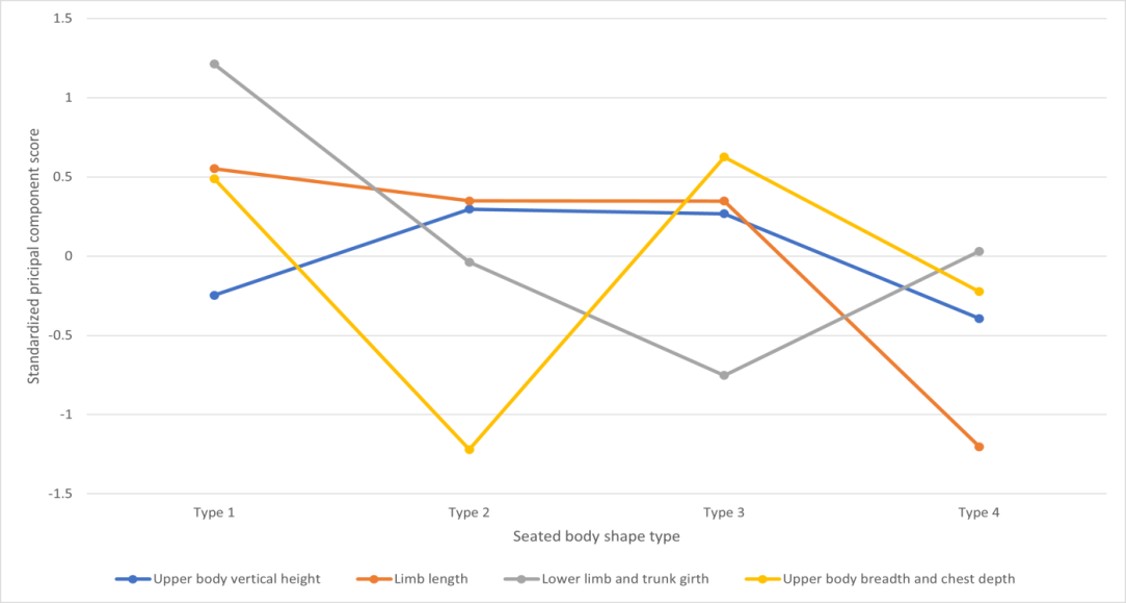
척수손상 남성 휠체어 사용자의 착석 체형 유형별 인체치수 및 형태지수의 차이를 비교한 결과는 Table 8과 같다. 유형별 특성을 구체적으로 파악하기 위하여 주성분분석과 군집분석에 사용된 주요 인체치수뿐 아니라 군집 형성에 직접 사용하지 않은 추가 측정치와 형태지수도 함께 비교하였다. Table 8의 통계적 비교는 군집별 형태 특성을 기술하기 위한 것으로, 유의성은 FDR 보정을 적용하지 않은 p 값을 기준으로 제시하였다. 분산의 동질성을 검토한 결과, 앉은넙다리중간둘레, 허리너비 및 허리너비지수는 등분산 가정을 충족하지 않아 Welch의 일원분산분석과 Games–Howell 사후검정을 적용하였으며, 나머지 항목에는 일반 일원분산분석과 Tukey HSD 사후검정을 적용하였다.
|
Component |
Item |
Type 1 (n=51) |
Type 2 (n=51) |
Type 3 (n=82) |
Type 4 (n=62) |
Test |
η2 [95% CI] |
|
Upper body |
Sitting eye height |
71.74BC |
73.44AB |
73.56A |
70.04C |
F=12.838*** |
.137 [.060,
.210] |
|
3.74 |
3.72 |
3.54 |
3.87 |
||||
|
Sitting height |
83.54A |
84.72A |
84.78A |
81.14B |
F=12.810*** |
.137 [.060,
.210] |
|
|
3.76 |
4.29 |
3.40 |
3.90 |
||||
|
Sitting shoulder height |
52.30AB |
53.46A |
53.07A |
50.71B |
F=7.788*** |
.088 [.025,
.153] |
|
|
3.41 |
3.24 |
3.16 |
3.80 |
||||
|
Sitting cervical height |
59.05A |
59.35A |
60.08A |
56.89B |
F=10.002*** |
.110 [.040,
.179] |
|
|
3.30 |
3.04 |
3.55 |
4.04 |
||||
|
Sitting elbow height |
19.79 |
19.99 |
19.81 |
19.23 |
F=.579 |
.007 [.000,
.030] |
|
|
3.49 |
2.84 |
3.30 |
3.65 |
||||
|
Limb
length |
Sitting knee height |
50.78A |
48.89B |
49.97AB |
44.99C |
F=75.452*** |
.483 [.392,
.550] |
|
2.45 |
2.32 |
2.44 |
1.96 |
||||
|
Sitting
buttock-knee |
58.62A |
55.01B |
55.95B |
51.14C |
F=63.012*** |
.439 [.344,
.509] |
|
|
2.98 |
3.20 |
2.64 |
3.16 |
||||
|
Sitting popliteal height |
41.17A |
39.98B |
41.41A |
36.81C |
F=59.600*** |
.425 [.329,
.497] |
|
|
2.37 |
2.44 |
2.03 |
2.03 |
||||
|
Sitting
buttock-popliteal |
49.51A |
46.28B |
47.51B |
43.13C |
F=53.231*** |
.398 [.300,
.472] |
|
|
2.79 |
2.89 |
2.76 |
2.80 |
||||
|
Arm length |
56.80A |
56.70A |
56.23A |
53.49B |
F=26.733*** |
.249 [.154,
.328] |
|
|
2.18 |
2.52 |
2.38 |
2.25 |
||||
|
Lower limb
and |
Sitting
mid-thigh |
52.01A |
44.74B |
40.15C |
43.02B |
W=65.775*** |
.421 [.325,
.493] |
|
4.94 |
4.91 |
4.41 |
6.09 |
||||
|
Sitting
calf |
35.69A |
30.78B |
28.76C |
29.77BC |
F=49.361*** |
.380 [.282,
.455] |
|
|
3.01 |
3.49 |
2.97 |
3.81 |
||||
|
Sitting
waist circumference |
112.48A |
96.83B |
97.54B |
97.71B |
F=42.801*** |
.347 [.248,
.424] |
|
|
8.00 |
9.48 |
8.45 |
7.98 |
||||
|
Neck circumference |
44.94A |
41.36B |
42.19B |
42.50B |
F=15.516*** |
.161 [.079,
.237] |
|
|
2.89 |
2.68 |
2.81 |
2.88 |
||||
|
Upper body |
Upper arm breadth |
48.79A |
42.94B |
47.97A |
43.99B |
F=67.231*** |
.455 [.361,
.524] |
|
2.80 |
2.62 |
2.57 |
2.75 |
||||
|
Chest depth |
23.31A |
18.42D |
22.17B |
20.21C |
F=54.248*** |
.402 [.305,
.476] |
|
|
2.02 |
2.23 |
2.08 |
2.30 |
||||
|
Biacromial breadth |
40.24A |
36.42B |
40.56A |
36.49B |
F=73.719*** |
.477 [.385,
.545] |
|
|
2.36 |
2.00 |
1.96 |
2.12 |
||||
|
Additional |
Weight |
83.47A |
65.75B |
68.09B |
63.91B |
F=47.955*** |
.373 [.275,
.448] |
|
9.87 |
9.38 |
9.49 |
8.96 |
||||
|
Sitting abdominal depth |
30.19A |
24.08C |
26.26B |
24.85BC |
F=34.936*** |
.302 [.205,
.381] |
|
|
2.92 |
3.19 |
3.52 |
3.43 |
||||
|
Waist breadth |
36.39A |
29.77C |
32.22B |
29.91C |
W=59.167*** |
.439 [.344,
.510] |
|
|
2.46 |
3.52 |
2.51 |
2.86 |
||||
|
Sitting buttock breadth |
40.60A |
35.22C |
37.24B |
34.95C |
F=53.662*** |
.399 [.302,
.473] |
|
|
2.49 |
2.71 |
2.40 |
2.84 |
||||
|
Shoulder width index |
48.24A |
43.07C |
47.91A |
45.08B |
F=36.152*** |
.309 [.212,
.388] |
|
|
3.29 |
4.23 |
3.19 |
3.93 |
||||
|
Waist width index |
43.62A |
35.19C |
38.05B |
36.94BC |
W=54.478*** |
.391 [.294,
.465] |
|
|
3.29 |
4.23 |
3.19 |
3.93 |
||||
|
Chest depth index |
58.09A |
50.58C |
54.78B |
55.41AB |
F=15.154*** |
.158 [.076,
.233] |
|
|
5.84 |
5.55 |
5.72 |
5.71 |
||||
|
Abdominal
protrusion |
83.00 |
81.04 |
81.38 |
83.05 |
F=1.141 |
.014 [.000,
.045] |
|
|
6.30 |
7.13 |
8.00 |
8.40 |
||||
|
Shoulder height ratio |
62.58 |
63.11 |
62.57 |
62.45 |
F=.793 |
.010 [.000,
.036] |
|
|
2.47 |
2.40 |
2.19 |
2.66 |
||||
|
Waist circumference ratio |
134.76A |
114.41C |
115.14C |
120.44B |
F=51.449*** |
.389 [.292,
.464] |
|
|
9.28 |
11.03 |
10.09 |
8.39 |
||||
|
Note. Values are presented as means in the
first row and standard deviations in the second row. F indicates one-way
ANOVA, and W indicates Welch's ANOVA. Different superscript letters indicate differences according
to Tukey HSD or Games–Howell post-hoc
comparisons. η2 is presented with its 95% confidence interval. The
statistical comparisons are provided to describe the morphological
characteristics of the clusters and should not be interpreted as independent
validation or confirmatory hypothesis testing. ***p<.001 |
|||||||
상체 수직 높이 관련 항목에서는 앉은눈높이, 앉은키, 앉은어깨높이 및 앉은목뒤높이에서 유형 간 유의한 차이가 나타났다. 앉은눈높이는 유형 3이 가장 높고 유형 4가 가장 낮았으며, 앉은키는 유형 1, 유형 2 및 유형 3이 유사한 수준을 보였고 유형 4가 가장 낮았다. 앉은어깨높이는 유형 2와 유형 3이 상대적으로 높았고, 앉은목뒤높이는 유형 1, 유형 2 및 유형 3이 유형 4보다 높게 나타났다. 반면 앉은팔꿈치높이는 유형 간 유의한 차이가 나타나지 않았다. 이는 유형 2와 유형 3의 상체 수직 높이가 비교적 큰 반면, 유형 4는 전반적으로 상체 수직 높이가 작은 체형임을 보여준다.
사지 길이 관련 항목에서는 앉은무릎높이, 앉은엉덩이무릎수평길이, 앉은오금높이, 앉은엉덩이오금수평길이 및 팔길이에서 모두 유형 간 유의한 차이가 나타났다. 앉은무릎높이는 유형 1이 가장 높고 유형 4가 가장 낮았으며, 유형 3은 유형 1 및 유형 2와 각각 유의한 차이가 없는 중간적 특성을 보였다. 앉은엉덩이무릎수평길이와 앉은엉덩이오금수평길이는 유형 1이 가장 길고, 유형 2와 유형 3이 중간 수준, 유형 4가 가장 짧게 나타났다. 앉은오금높이는 유형 1과 유형 3이 높고 유형 4가 가장 낮았다. 팔길이도 유형 1, 유형 2 및 유형 3이 유사한 수준을 보인 반면 유형 4가 유의하게 짧았다. 이러한 결과는 유형 4가 상 · 하지 길이와 착석 상태의 전후 수평 거리가 전반적으로 작은 체형임을 나타낸다.
하지 및 체간 둘레 관련 항목에서는 앉은넙다리중간둘레, 앉은장딴지둘레, 앉은배꼽수준허리둘레 및 목둘레에서 모두 유의한 차이가 나타났다. 앉은넙다리중간둘레는 유형 1이 가장 크고 유형 3이 가장 작았으며, 유형 2와 유형 4는 중간 수준을 보였다. 앉은장딴지둘레도 유형 1이 가장 크게 나타났고 유형 3이 가장 작았으며, 유형 4는 유형 2 및 유형 3과 모두 유의한 차이가 없는 중간적 특성을 보였다. 앉은배꼽수준허리둘레와 목둘레는 유형 1이 유형 2, 유형 3 및 유형 4보다 유의하게 컸다. 따라서 유형 1은 하지와 체간의 둘레 및 전반적인 체적 발달이 가장 두드러지는 반면, 유형 3은 하지 및 체간 둘레가 상대적으로 작은 체형으로 해석할 수 있다.
상체 너비 및 가슴두께 관련 항목에서는 위팔사이너비, 가슴두께 및 어깨사이너비에서 모두 유형 간 유의한 차이가 나타났다. 위팔사이너비와 어깨사이너비는 유형 1과 유형 3이 높고 유형 2와 유형 4가 낮게 나타났다. 가슴두께는 유형 1이 가장 크고 유형 3, 유형 4, 유형 2의 순으로 나타나 네 유형이 서로 다른 특성을 보였다. 이는 유형 1이 하지와 체간 둘레뿐 아니라 상체 너비와 가슴두께도 함께 발달한 체형임을 보여준다. 유형 3은 하지 및 체간 둘레는 작지만 상체의 횡적 너비와 가슴두께가 발달한 반면, 유형 2는 상체 너비와 가슴두께가 가장 작은 체형으로 나타났다.
추가 측정치 및 형태지수에서는 체중, 앉은배두께, 허리너비, 앉은엉덩이너비, 어깨너비지수, 허리너비지수, 흉부입체지수 및 허리둘레비율지수에서 유형 간 유의한 차이가 나타났다. 체중은 유형 1이 유형 2, 유형 3 및 유형 4보다 유의하게 높았으며, 유형 2, 유형 3 및 유형 4 간에는 유의한 차이가 나타나지 않았다. 앉은배두께, 허리너비 및 앉은엉덩이너비도 유형 1이 가장 크게 나타났다. 어깨너비지수는 유형 1과 유형 3이 높고 유형 2가 가장 낮았으며, 유형 4는 중간 수준을 보였다. 허리너비지수는 유형 1이 가장 높고 유형 2가 가장 낮았으며, 유형 4는 유형 2 및 유형 3과 모두 유의한 차이가 없는 중간적 특성을 나타냈다. 흉부입체지수는 유형 1이 가장 높고 유형 2가 가장 낮았으며, 허리둘레비율지수는 유형 1이 가장 높고 유형 2와 유형 3이 가장 낮았다. 그러나 복부돌출지수와 어깨높이비율지수에서는 유형 간 유의한 차이가 나타나지 않았다.
유형 간 차이의 효과크기는 앉은무릎높이(η2=.483), 어깨사이너비(η2=.477), 위팔사이너비(η2=.455), 앉은엉덩이무릎수평길이와 허리너비(각각 η2=.439), 앉은오금높이(η2=.425) 및 앉은넙다리중간둘레(η2=.421)에서 상대적으로 크게 나타났다. 그러나 유형 간 유의한 차이가 나타나지 않은 앉은팔꿈치높이(η2=.007), 복부돌출지수(η2=.014) 및 어깨높이비율지수(η2=.010)의 효과크기는 작은 수준이었다.
유형 1은 하지 및 체간 둘레가 가장 발달하고 사지 길이와 상체 너비 및 가슴두께도 평균보다 크게 나타난 사지 길이 및 둘레 발달형으로 해석할 수 있다. 유형 2는 상체 수직 높이와 사지 길이는 비교적 크지만 상체 너비와 가슴두께가 가장 작은 상체 협소형으로 나타났다. 유형 3은 하지 및 체간 둘레는 가장 작지만 상체 너비와 가슴두께가 발달한 둘레 세장 · 상체 너비 발달형으로 구분되었다. 유형 4는 상체 수직 높이와 상 · 하지 길이가 전반적으로 작고 둘레는 평균에 가까운 사지 길이 축소형으로 나타났다. 이러한 결과는 척수손상 남성 휠체어 사용자의 착석 체형이 단순한 신체 크기 차이가 아니라 상체 높이, 사지 길이, 하지 및 체간 둘레, 상체 너비와 가슴두께의 서로 다른 조합에 따라 유형화될 수 있음을 보여준다.
연령집단에 따른 착석 체형 유형의 분포를 분석한 결과, 전체 셀 중 기대빈도가 5 미만인 셀이 33.3%로 나타나 Fisher–Freeman–Halton 정확검정의 Monte Carlo 방법을 적용하였다. 분석 결과, 연령집단과 착석 체형 유형 간에는 통계적으로 유의한 관련성이 나타났다(Monte Carlo p=.037). Pearson 카이제곱검정의 Monte Carlo 유의확률도 .044로 나타나 동일한 결과가 확인되었으며, 관련성의 크기는 Cramer's V=.161로 작은 수준이었다.
20~39세 집단에서는 Type 2와 Type 3이 각각 28.6%로 가장 높은 비율을 보였다. 40~59세 집단에서는 Type 3이 32.6%로 가장 높았으며, Type 1이 25.6%, Type 2가 24.0%, Type 4가 17.8%로 나타났다. 60~79세 집단에서는 Type 3과 Type 4가 각각 35.0%로 가장 높은 비율을 보였다. 특히 60~79세 집단의 Type 4는 표준화 잔차가 2.0으로 나타나 기대빈도보다 상대적으로 많이 분포하는 경향을 보였다. 이러한 결과는 연령이 높은 집단에서 Type 4의 비율이 증가하는 반면, Type 1과 Type 2의 비율은 상대적으로 감소하는 경향이 있음을 보여준다(Table 9).
|
Age group |
Type
1 |
Type
2 |
Type
3 |
Type
4 |
Total |
|
20~39 |
3
(21.4%) |
4
(28.6%) |
4
(28.6%) |
3 (21.4%) |
14
(100.0%) |
|
40~59 |
33
(25.6%) |
31
(24.0%) |
42
(32.6%) |
23 (17.8%) |
129
(100.0%) |
|
60~79 |
15
(14.6%) |
16
(15.5%) |
36
(35.0%) |
36 (35.0%) |
103
(100.0%) |
|
Total |
51
(20.7%) |
51
(20.7%) |
82
(33.3%) |
62 (25.2%) |
246
(100.0%) |
|
Note.Values are presented as n (% within age
group). Fisher–Freeman–Halton exact test using the Monte Carlo method, p=.037; Cramer's V=.161 |
|||||
본 연구에서는 척수손상 남성 휠체어 사용자의 착석 체형을 구성하는 형태적 차원으로 상체 수직 높이, 사지 길이, 하지 및 체간 둘레, 상체 너비 및 가슴두께의 4개 주성분이 도출되었다. 이는 착석 체형이 하나의 대표 둘레치수나 전반적인 신체 크기만으로 설명되기보다 수직적 높이, 상 · 하지 · 길이, 둘레, 횡적 너비 및 전후 두께가 서로 구분되는 다차원적 구조임을 보여준다. 기존의 휠체어 사용자 대상 인체측정 연구가 착석 상태의 높이 · 너비 · 깊이 및 공간 점유 범위를 제시하거나(Paquet and Feathers, 2004; Adnan et al., 2019), 상반신 측면 또는 하반신과 같은 특정 부위의 체형을 분류한 것과 달리(Park et al., 2019; Xing et al., 2024), 본 연구는 체간 · 상지 · 하지를 포함한 전반적인 착석 체형의 형태적 차원을 종합적으로 분석하였다는 점에서 차별성을 갖는다.
상체 수직 높이는 앉은키와 앉은어깨높이 등 착석 상태에서의 상체 길이와 각 기준점의 수직적 위치를 나타낸다. 이러한 치수는 상의길이, 등길이, 진동 위치 및 몸판과 소매의 균형을 설정하는 데 중요한 기준이 될 수 있다. 사지 길이는 앉은무릎높이, 엉덩이에서 무릎 및 오금까지의 수평길이, 팔길이를 포함하여 착석 상태에서의 상 · 하지 길이와 공간 점유 특성을 반영하였다. 이는 소매와 바지길이뿐 아니라 무릎 위치, 좌면 접촉 범위 및 휠체어 조작 시 필요한 동작 여유를 검토하는 데 활용될 수 있다.
하지 및 체간 둘레는 넙다리, 장딴지, 허리 및 목 부위의 체적 발달을 나타내며, 상체 너비 및 가슴두께는 어깨와 위팔 부위의 횡적 크기와 흉부의 전후 입체성을 반영하였다. 착석 자세에서는 복부와 넙다리의 연부조직이 재배치되고 신체와 좌면 사이의 접촉 범위가 증가할 수 있어 기립 상태의 둘레치수만으로는 착석 시의 의복 여유와 압박을 충분히 파악하기 어려울 가능성이 있다. 또한, 비슷한 허리둘레를 가진 사용자라도 상체 너비와 가슴두께가 다를 수 있으므로, 휠체어 사용자용 의복 치수체계에서는 길이 · 둘레 · 너비 · 두께를 독립적인 설계 차원으로 고려할 필요가 있다.
주성분점수를 이용한 군집분석 결과, 착석 체형은 사지 길이 및 둘레 발달형, 상체 협소형, 둘레 세장 · 상체 너비 발달형 및 사지 길이 축소형의 4개 유형으로 분류되었다. 사지 길이 및 둘레 발달형은 하지와 체간의 둘레가 가장 발달하였으며, 사지 길이와 상체 너비 및 가슴두께도 평균보다 큰 특성을 보였다. 상체 협소형은 상체 수직 높이와 사지 길이는 비교적 크지만 어깨와 위팔 부위의 너비 및 가슴두께가 작은 특성을 나타냈다. 둘레 세장 · 상체 너비 발달형은 하지 및 체간 둘레는 작지만 어깨와 상부 체간의 횡적 너비 및 가슴두께가 발달하였고, 사지 길이 축소형은 사지 길이와 상체 수직 높이가 전반적으로 작게 나타났다. 이러한 결과는 동일한 성별과 장애 유형의 휠체어 사용자라 하더라도 신체 각 부위의 비례와 형태 조합이 서로 다르며, 하나의 기준치수에 따른 일률적인 패턴 확대 · 축소로는 이러한 변이를 충분히 반영하기 어려울 수 있음을 보여준다.
유형별 의복 설계에서는 사지 길이 및 둘레 발달형의 경우 복부 · 허리 · 넙다리 부위의 여유량과 착석 시 압박을 우선적으로 검토할 필요가 있다. 상체 협소형은 상의와 소매의 길이를 확보하면서 어깨와 가슴 부위에 과도한 여유가 발생하지 않도록 조정해야 하며, 둘레 세장 · 상체 너비 발달형은 어깨선, 앞 · 뒤품, 진동 및 가슴 부위의 부분적인 확대를 고려할 수 있다. 사지 길이 축소형은 상의 · 소매 · 바지길이를 조정하여 착석 시 과도한 원단의 중첩과 주름이 발생하지 않도록 하는 것이 중요하다. 다만 이러한 설계 방향은 인체치수와 유형 특성에 근거한 제안으로, 실제 패턴 개발과 착의평가를 통한 검증이 필요하다.
연령집단과 체형 유형의 분포 간에는 통계적으로 유의한 관련성이 나타났으나, Cramer's V가 .161로 관련성의 크기는 작은 수준이었다. 특히 60~79세 집단에서는 사지 길이와 상체 수직 높이가 작은 사지 길이 축소형의 비율이 상대적으로 높게 나타났다. 그러나 본 연구는 서로 다른 연령집단을 비교한 횡단연구이므로 이를 개인의 노화에 따른 체형 변화로 해석할 수 없다. 또한 20~39세 집단의 표본 수가 적고 일부 셀의 기대빈도가 낮아 연령집단별 유형 분포는 탐색적으로 해석할 필요가 있다.
본 연구는 남성 휠체어 사용자만을 대상으로 하였으며, 원자료의 제한으로 척수손상 수준, 완전 · 불완전 손상 여부, 손상 후 경과기간, 휠체어 사용기간 및 체간 조절능력을 분석에 포함하지 못하였다. 또한 측정은 표준화된 직접측정 절차에 따라 수행되었으나, 연구대상자가 사용한 개인 휠체어의 좌면, 쿠션, 등받이, 골반 지지 및 발 지지조건은 통제되지 않았다. 이러한 착석 지지조건의 차이가 자세와 일부 인체치수에 영향을 미쳤을 가능성이 있으므로 결과 해석에 주의가 필요하다. 또한, 서로 다른 초기 중심값을 적용한 반복분석에서 분류 일치율이 일정한 수준의 변동을 보여 일부 사례의 유형 분류가 초기값의 영향을 받을 가능성이 확인되었으며, 독립표본을 이용한 분류의 재현성과 외적 타당성도 검증하지 못하였다. 실제 의복 패턴 개발과 착의평가도 수행하지 않았으므로, 본 연구에서 도출된 네 가지 착석 체형 유형은 확정적 분류체계라기보다 척수손상 남성 휠체어 사용자의 착석 인체치수에 기초한 탐색적 체형분류로 해석해야 한다. 향후에는 다양한 성별과 장애 유형을 포함한 독립표본 검증, 임상정보와 체형 유형의 관련성 분석, 3차원 인체스캔 및 유형별 패턴의 가상 · 실물 착의평가가 이루어질 필요가 있다.
본 연구는 척수손상 남성 휠체어 사용자 246명의 착석 인체치수를 분석하여 착석 체형의 주요 형태적 차원을 도출하고 체형 유형을 분류하였다. 주성분분석 결과, 착석 체형은 상체 수직 높이, 사지길이, 하지 및 체간 둘레, 상체 너비 및 가슴두께의 4개 주성분으로 구성되었으며, 누적설명분산은 77.97%였다.
군집분석 결과, 착석 체형은 사지 길이와 하지 및 체간 둘레가 발달한 '사지 길이 및 둘레 발달형(Type 1)', 상체의 횡적 너비와 가슴두께가 작은 '상체 협소형(Type 2)', 하지 및 체간 둘레는 작지만 상체 너비와 가슴두께가 발달한 '둘레 세장 · 상체 너비 발달형(Type 3)', 상 · 하지 길이와 상체 수직 높이가 전반적으로 작은 '사지 길이 축소형(Type 4)'의 4개 유형으로 분류되었다.
유형 간에는 상체 높이, 사지 길이, 하지 · 체간 둘레, 상체 너비와 가슴두께뿐 아니라 다수의 형태지수에서도 유의한 차이가 나타났다. 이는 척수손상 남성 휠체어 사용자의 착석 체형을 하나의 둘레치수나 전반적인 신체 크기만으로 분류하기 어렵고, 길이 · 둘레 · 너비 · 두께의 조합을 함께 고려해야 함을 보여준다.
본 연구는 기존의 특정 신체 부위 중심 연구에서 나아가 척수손상 남성의 전반적인 착석 체형을 다차원적으로 유형화했다는 점에서 의의가 있다. 연구 결과는 향후 휠체어 사용자용 의복 치수체계와 패턴 설계에서 고려해야 할 주요 인체치수와 체형 변이를 파악하기 위한 기초자료로 활용될 수 있다. 다만 도출된 유형은 독립표본과 실제 착의평가를 통해 검증되지 않은 탐색적 분류이므로, 후속연구에서는 임상정보와 3차원 인체자료를 포함한 체형분류의 재검증과 유형별 의복 설계 및 착의 적합성 평가가 필요하다.
References
1. Adnan, N., Dawal, S.Z.M., Yusoff, N. and Ngadiman, N.H.A., Applied anthropometric for wheelchair user in Malaysia, Measurement, 136, 587-595, 2019. doi:10.1016/j.measurement.2018.11.002
Google Scholar
2. Ashdown, S.P., Sizing in clothing: Developing effective sizing systems for ready-to-wear clothing, Woodhead Publishing, 2007.
Google Scholar
3. Feng, Q. and Hui, C.L., Clothing needs for wheelchair users: A systematic literature review, Advances in Aging Research, 10(1), 1-30, 2021. doi:10.4236/aar.2021.101001
Google Scholar
4. Giangregorio, L. and McCartney, N., Bone loss and muscle atrophy in spinal cord injury: Epidemiology, fracture prediction, and rehabilitation strategies, Journal of Spinal Cord Medicine, 29(5), 489-500, 2006. doi:10.1080/10790268.2006.11753898
Google Scholar
5. Lamb, J.M., Disability and the social importance of appearance, Clothing and Textiles Research Journal, 19(3), 134-143, 2001. doi: 10.1177/0887302X0101900304
Google Scholar
6. Ministry of Health and Welfare, 2024 statistics on registered persons with disabilities, Ministry of Health and Welfare, 2025. https://www.mohw.go.kr
7. Paquet, V. and Feathers, D., An anthropometric study of manual and powered wheelchair users, International Journal of Industrial Ergonomics, 33(3), 191-204, 2004. doi:10.1016/j.ergon.2003.10.003
Google Scholar
8. Park, J., Park, K., Lee, B., You, H. and Yang, C., Classification of upper body shapes among korean male wheelchair users to improve clothing fit, Assistive Technology, 31(1), 34-43, 2019. doi:10.1080/10400435.2017.1335359
Google Scholar
9. Raguindin, P.F., Bertolo, A., Zeh, R.M., Fränk, G., Itodo, O.A., Capossela, S., Bally, L., Minder, B., Brach, M., Eriks-Hoogland, I., Stoyanov, J., Muka, T. and Glistic, M., Body composition according to spinal cord injury level: A systematic review and meta-analysis, Journal of Clinical Medicine, 10(17), 3911, 2021. doi:10.3390/jcm10173911
Google Scholar
10. Rana, M.R., McBee-Black, K. and Swazan, I.S., Adaptive apparel for people with disabilities: A systematic literature review and research agenda, International Journal of Consumer Stuidies, 48(3), 2024. doi:10.1111/ijcs.13057
Google Scholar
11. Sprigle, S. and Sonenblum, S.E., Assessing evidence supporting redistribution of pressure for pressure ulcer prevention: A review, Journal of Rehabilitation Research and Development, 48(3), 203-213, 2011. doi:10.1682/JRRD.2010.05.0102
Google Scholar
12. Xing, L., Zakaria, N. and Ruznan, W.S., Classification of lower limb body shapes of paralysed female wheelchair users in Hebei, China: analysis of anthropometric data using clustering approach, Ergonomics, 67(9), 1190-1197, 2024. doi:10.1080/ 00140139.2023.2289855
Google Scholar
PIDS App ServiceClick here!
