eISSN: 2093-8462 http://jesk.or.kr
Open Access, Peer-reviewed

eISSN: 2093-8462 http://jesk.or.kr
Open Access, Peer-reviewed
Seung-Kweon Hong
10.5143/JESK.2026.45.4.351 Epub 2026 September 01
Abstract
Objective: This study aims to investigate the mouse cursor trajectory during tasks involving pointing at a target moving in a two-dimensional space, and to compare it with the trajectory observed during stationary target pointing.
Background: The traditional Fitts' law, which describes the time and accuracy of pointing tasks, fails to explain tasks involving moving targets. To understand the characteristics of pointing at a moving target, research on the movement trajectory of the mouse cursor is required. Although studies on cursor trajectories have been conducted previously, they have been limited to investigating trajectories during stationary target pointing tasks.
Method: The time interval from the initiation of cursor movement to the target click was divided into five stages. In each stage, we measured and analyzed whether the cursor position was located above or below the straight line connecting the starting point and the destination. Changes in the cursor position were measured while systematically varying the target speed, target size, and the distance between the target and the starting point.
Results: Stationary target pointing placed the cursor below the line in Stages 1~2 and above in Stages 3~5, whereas moving targets showed the opposite trend, which became more pronounced at higher speeds. Furthermore, while there were 32 possible mouse cursor trajectories for target pointing, participants utilized only 6 trajectories 75.8% of the time, demonstrating a preference for simple paths over complex ones. For moving targets, the preferred paths were Below-Below-Below- Below-Below (22.9%), Above-Below-Below-Below-Below (13.6%), and Above-Above- Below-Below-Below (8.1%). For stationary targets, the preferred paths were Above- Above-Above-Above-Above (14.8%), Below-Below-Above-Above-Above (9.0%) and Below-Above-Above-Above-Above (7.4%).
Conclusion: The mouse cursor movement trajectories for pointing at stationary targets differed significantly from those for pointing at moving targets. This discrepancy in cursor trajectories is expected to influence pointing times. Therefore, when developing a modified Fitts' law for moving targets, models that incorporate these variations in cursor trajectories should be proposed.
Application: The findings of this study offer valuable insights into understanding and leveraging the characteristics of moving target pointing tasks.
Keywords
Fitts' Law Moving target Mouse-cursor movement path Prediction of future position
컴퓨터 마우스를 이용하여 화면상의 특정한 목표물을 선택하는 포인팅 작업은 대표적인 인간-컴퓨터 상호작용이라고 할 수 있다. 시작점에서 마우스 커서를 출발시켜서 목표물에 접근하고 목표물에 도달하여 목표물을 포인팅한다. 이 작업의 속도와 정확성은 Fitts의 법칙(Fitts' law)에 의해 설명되고 예측되고 있다. Fitts는 1954년 스타일러스로 두 지점을 번갈아 두드리거나, 핀이나 고리(원반)를 목표 지점으로 옮기는 물리적 과업을 수행하는 실험을 실시하였다(Fitts, 1954). 이 실험의 결과 정립된 Fitts 법칙은 오늘날 마우스 커서를 이동시켜 화면상의 특정 표적을 선택하는 디지털 인터랙션의 효율성을 예측하는 핵심 모델로 사용되고 있다(MacKenzie, 1992).
Fitts 실험 이후에 많은 연구자들은 최초에 제안된 Fitts 법칙을 변형하여 새로운 모델들을 제시해왔다. Fitts 법칙은 인간의 움직임을 완벽히 설명하기에는 단순한 면이 있어, 다양한 상황(특히 컴퓨터 환경)에 맞춰 정교하게 수정된 모델들이 제안되었다. MacKenzie (1992)는 이동 거리가 짧을 때 정보 전송량(ID)이 음수(-)가 나오는 수학적 결함을 개선하기 위해 정보이론에 입각한 새로운 모델을 제안하였다. Accot와 Zhai (1997)은 좁고 긴 터널을 통과하는 것처럼 정해진 경로를 이탈하지 않고 이동해야 할 때의 시간을 예측하는 모델을 제시하였다(Accot and Zhai, 1997). 또한 스타일러스 펜과 같이 긴 도구를 사용하여 목표물을 포인팅하는 작업에서 도구의 길이라는 변수를 추가한 수정된 모델을 제시하였다(Baird et al., 2002).
본 연구는 움직이는 표적을 포인팅하는 과업을 대상으로 하고 있다. 대부분의 기존 Fitts 모델들은 목표물이 움직이지 않는 정적인 목표물을 대상으로 한 모델이었다. 그러나 요즈음 컴퓨팅 환경에서는 움직이는 표적을 포인팅하는 작업이 빈번하게 수행되고 있다. 특히, 컴퓨터 게임은 매우 동적인 환경을 제공하고 있으며, 목표물이 이동하는 경우가 많다. 게임 플레이어는 움직이는 표적을 빈번히 포인팅해야 한다. 이동하는 표적의 속도를 고려한 새로운 Fitts 모델의 개발이 요구된다고 할 수 있다. 그러나 움직이는 목표물을 포인팅하는 작업에 대한 Fitts 모델 연구는 필요성과 중요성에 비해 연구수행 사례들이 부족한 상황이다. 관련된 초기연구는 목표물이 직선으로 이동하는 간단한 경우를 상정하여 수행되었다. 목표물이 시작점으로 일정한 속도를 접근하는 경우와 목표물이 시작점으로부터 일정한 속도로 멀어지는 경우에 국한한 모델을 제안되었다. 즉 1차원으로 이동하는 표적에 대한 연구였다(Hoffmann, 1991; Jagacinski et al., 1980).
최근에 1차원 이동 표적을 벗어나 2차원 이동 표적에 대한 연구가 진행되고 있다. 2차원 환경에서 이동하는 표적을 마우스로 포인팅 작업에서 목표물의 클릭 지점의 위치를 측정하고 분석하여 종점 클릭 위치를 모델링하였다(Huang et al., 2019). 또한 이 모델을 확장하여 3D 이동 표적의 모델링도 시도하였다(Zheng et al., 2025). 종점 위치에 대한 연구는 이동 표적의 Fitts 모델의 특성을 규명하는 중요한 연구라고 할 수 있다. 2차원 이동 표적 Fitts 모델 개발의 전 단계에서 수행되어야 하는 선행 연구라고 할 수 있다.
본 연구에서는 2차원 이동 표적 Fitts 모델 개발을 위한 다른 각도의 선행 연구로써 2차원 이동 표적을 포인팅 과정에서 마우스 커서의 이동 경로를 측정하고 분석하려고 한다. Fitts는 초기실험에서 표적으로 손이 이동하는 경로에 대한 가정을 하였다. 피실험자들이 Fitts 작업에 충분히 숙달되었기 때문에 최적의 이동 경로를 선택하여 수행한다고 전제하였다. 즉 각 피실험자들은 손 이동 속도와 포인팅의 정확도를 최적화하는 손의 이동 경로를 스스로 선택한다고 가정하였다. 또한 다른 연구자들은 시작점에서 출발하여 표적에 도달하는 과정에서 전반부의 손 이동은 탄도운동을 하며, 후반부에는 시각적으로 통제되는 운동을 한다는 연구결과를 제시하였다(Chan et al., 2016; Hoffmann, 2016).
최근에는 마우스를 사용하는 포인팅 작업에서 마우스 커서의 이동 경로를 측정하고 분석하는 연구가 수행되었다(Murata et al., 2025). 그들의 실험은 정적인 표적을 포인팅하는 실험이었으며, 마우스 커서 이동을 1단계 이동 속도 증가 단계, 2단계 이동 속도 감소 단계 그리고 3단계 목표 지점으로 접근하는 단계로 구분하고, 각 단계를 측정하고 분석하였다. 분석결과는 1단계에서는 소요시간은 이동 방향과 목표물의 크기에 영향을 받지 않았다. 2단계의 소요시간은 이동 방향에만 영향을 받았으며, 3단계의 소요시간은 목표물의 크기에만 영향을 받았다.
본 연구는 2차원 이동 표적에 대한 연구이며, 마우스 커서의 이동 경로를 분석하는 연구다. 시작점에서 종점 까지를 5단계로 구분하여 각 단계의 커서 위치와 속도를 측정하며, 마우스 커서 이동 경로를 조명하고자 한다. 세부적인 연구 목적은 첫째 정적인 표적과 움직이는 표적을 포인팅할 때 마우스 커서의 이동 경로가 상이한지를 조사하는 것이다. 둘째는 잠재적인 다양한 마우스 커서 이동 경로 중에 피실험자들은 어떤 경로를 선호하는지 조사하고, 고정 표적인 경우와 움직이는 표적의 경우 선호하는 경로가 상이한지 조사하는 것이다.
2.1 Participants
본 연구를 위해 총 14명(남 11명, 여 3명)의 피험자가 모집되었다. 참여진의 평균 연령은 24.7세(표준편차 2.6)이며, 전원 마우스 조작이 능숙하고 Fitts 법칙(Fitts' Law)에 대해 이해하고 있었다. 또한, 모든 참가자는 0.8 이상의 교정 시력을 확보하여 화면 내 타겟을 식별하고 추적하는 데 신체적 제약이 없음을 확인했다.
2.2 Stimuli and apparatus
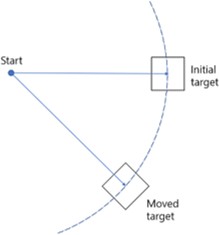
본 실험은 Windows 11 환경의 데스크톱(AMD Ryzen 7 5800X, 8-Core CPU)에서 진행되었다. 시각 자극은 34인치 LCD 모니터(3,440×1,440 해상도, 75Hz 재생률)를 통해 출력되었으며, Figure 1에 보이는 바와 실험용 소프트웨어는 C++ 언어로 자체 제작하였다. 실험 자극인 정사각형 표적은 원형 궤적을 따라 일정 속도로 이동한다. 이때 표적은 원의 중심과 연결된 직선과 항상 수직을 유지하도록 설계되었다. 실험 조건에 따라 원형 궤적의 직경과 표적의 크기를 각각 변화시켰으며, 참가자는 마우스 커서를 움직여 해당 표적을 클릭하는 과업을 수행했다. 데이터 수집을 위해 커서 위치는 45ms 간격으로 기록하였고, 시작점과 도착점에서의 클릭 시점 역시 각각 측정하였다.
2.3 Design of experiments
본 실험의 독립변수는 표적 너비(W), 이동 거리(A), 이동 속도(V) 세 가지이다. 우선 이동 거리(A)는 시작 지점부터 목표물 중심부까지의 간격을 의미하며, 150, 260, 370 픽셀로 구성하였다. 표적 너비(W)의 경우 가로와 세로가 동일한 정사각형 형태를 유지한 채 25, 33, 41 픽셀의 세 수준을 적용하였다. 이동하는 표적의 속도는 0, 100, 200 pixel/s로 설정하였다. 종속변수는 움직이는 마우스 커서의 위치이며, 시작점을 출장하여 45ms 간격으로 기록하였다. 또한 시작점과 도착점에서의 클릭 시점도 기록하였다. 실험은 모든 참가자가 모든 조건에 참여하는 반복 측정 설계로 진행되었으며, 조건별로 20회씩 반복 수행하였다.
3.1 Positional analysis of the mouse cursor in each of the five movement stages
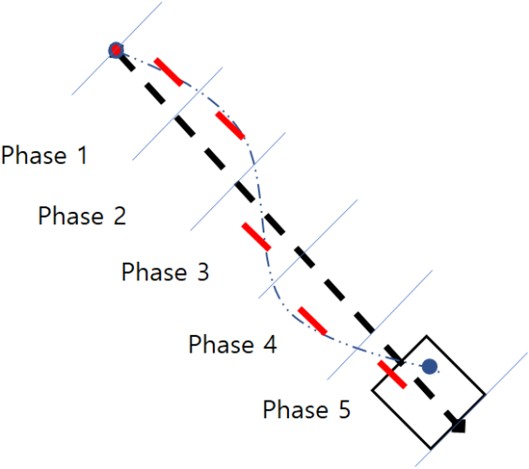
마우스 커서의 이동 경로를 분석하기 위해 시작점에서 표적 클릭까지의 시간을 5단계로 구분하였다. 1단계는 시작점에서 이동시간 1/6 시점까지, 2단계는 1/6 시점에서 2/6 시점까지, 3단계는 2/6 시점에서 3/6 시점까지, 3단계는 3/6 시점에서 4/6 시점까지, 4단계는 4/6 시점에서 5/6 시점까지, 5단계는 5/6 시점에서 종점(클릭 시점)까지로 설정하였다. 시작점에서 표적을 클릭하는 시점까지의 시간은 실험 조건과 피실험자의 마우스 커서 조작능력에 따라 변할 수 있다.
각 단계에서 마우스 커서의 위치를 측정하였다. 시작점과 표적 중심과 연결한 직선보다 커서의 위치가 위에 위치하는지 또는 아래에 위치하는지 측정하였다. 시작점과 표적 중심까지의 직선은 정적인 표적(V=0)인 경우에는 고정되어 있지만, 표적이 이동하는 경우(V=100, V=200)에는 직선이 표적 이동 속도와 피 실험자의 마우스 커서 이동 속도에 따라 변동된다. Figure 2는 마우스 커서 이동과정에서 관측된 마우스 커서 위치의 예를 보이고 있다. Figure 3은 표적 속도변화에 따른 각 단계별 마우스 커서 위치의 변화를 보이고 있다. 그래프의 Y축은 직선보다 마우스 커서의 위치가 위에 있는 경우를 나타낸 그래프다. 예를 들어 0.35는 관측된 특정 단계에서 35%가 직선보다 위에 마우스 커서가 위치하고 65%는 직선보다 커서의 위치가 아래쪽에 있었다는 것을 의미한다.
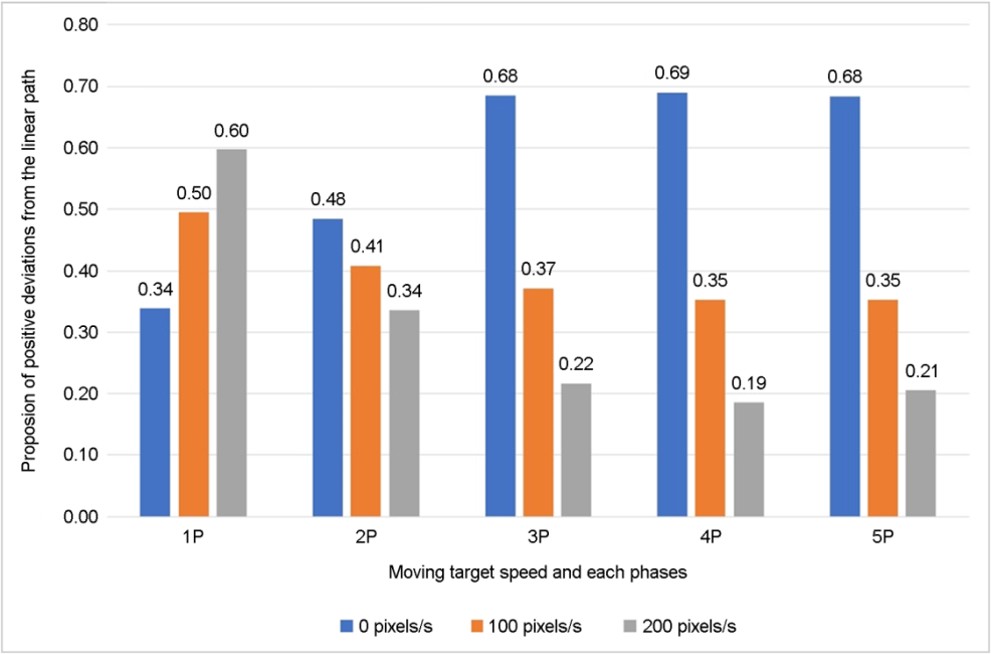
각 단계에서 표적 속도에 따른 커서의 위치 차이를 확인하기 위해 일원분산분석(One-way ANOVA)을 실시한 결과, 모든 단계에서 속도에 따른 커서의 위치 차이가 통계적으로 유의미하게 나타났다. 구체적으로 1단계에서는 속도가 빠를수록 커서의 위치가 유의하게 증가하였으며(F(2, 375) = 24.26, p < .001), 사후검정(Tukey's HSD) 결과 모든 속도 조건 간에 유의한 차이가 나타났다(V0 < V100 < V200). 2단계에서도 속도에 따른 차이가 유의하였으나(F(2, 375) = 10.74, p < .001), 사후검정 결과 V0 조건이 가장 작았고 V100과 V200 조건 간에는 유의한 차이가 없었다(V0 < V100 = V200). 반면, 3, 4, 5단계는 모두 속도가 빠를수록 커서의 위치가 유의하게 감소하는 동일한 경향성을 보였다(3단계: (F(2, 375) = 110.91, p < .001); 4단계: (F(2, 375) = 142.68, p < .001); 5단계: (F(2, 375) = 143.65, p < .001). 이 세 단계의 사후검정 결과 역시 모든 속도 조건 간에 유의한 차이가 확인되었다(V0 > V100 > V200). 이러한 결과는 정적인 표적에서는 마우스 커서 시작 시점에서는 직선경로보다 하단에 커서가 위치하다가 종점으로 접근하면서 직선경로의 상단에 마우스 커서가 위치하는 경향을 나타낸다. 반면에 동적인 표적을 포인팅하는 작업에서는 직선경로보다 하단에 마우스 커서가 위치하다가 시간의 경과와 함께 하단으로 이동하는 경향을 보이고 있다. 동적 표적의 속도가 증가하면 이러한 경향은 심화되었다.
3.2 User-preferred mouse cursor movement paths
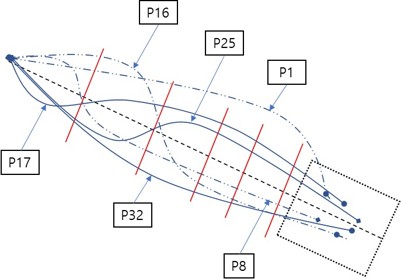
마우스 커서의 이동 경로를 분석하였다. 5단계의 마우스 커서 이동과정에서 발생할 수 있는 이동 경로는 32가지(2*2*2*2*2=32)가 된다. Table 1은 가능한 이동 경로 32가지를 나타내고 있다. 가장 복잡한 이동 경로는 1단계 상단, 2단계 하단, 3단계 상단 4단계 하단, 5단계 상단과 같이 각 단계에서 상단과 하단을 번갈아 가면서 마우스 커서가 이동하는 이동 경로며, 경로 11과 경로 22에 해당된다. 가장 단순한 지속적으로 상단에 머물거나 하단에 머무는 경우이며 경로 1과 경로 32에 해당된다.
|
Path |
P1 |
P2 |
P3 |
P4 |
P5 |
Path |
P1 |
P2 |
P3 |
P4 |
P5 |
|
1 |
UP |
UP |
UP |
UP |
UP |
17 |
DN |
UP |
UP |
UP |
UP |
|
2 |
UP |
UP |
UP |
UP |
DN |
18 |
DN |
UP |
UP |
UP |
DN |
|
3 |
UP |
UP |
UP |
DN |
UP |
19 |
DN |
UP |
UP |
DN |
UP |
|
4 |
UP |
UP |
UP |
DN |
DN |
20 |
DN |
UP |
UP |
DN |
DN |
|
5 |
UP |
UP |
DN |
UP |
UP |
21 |
DN |
UP |
DN |
UP |
UP |
|
6 |
UP |
UP |
DN |
UP |
DN |
22 |
DN |
UP |
DN |
UP |
DN |
|
7 |
UP |
UP |
DN |
DN |
UP |
23 |
DN |
UP |
DN |
DN |
UP |
|
8 |
UP |
UP |
DN |
DN |
DN |
24 |
DN |
UP |
DN |
DN |
DN |
|
9 |
UP |
DN |
UP |
UP |
UP |
25 |
DN |
DN |
UP |
UP |
UP |
|
10 |
UP |
DN |
UP |
UP |
DN |
26 |
DN |
DN |
UP |
UP |
DN |
|
11 |
UP |
DN |
UP |
DN |
UP |
27 |
DN |
DN |
UP |
DN |
UP |
|
12 |
UP |
DN |
UP |
DN |
DN |
28 |
DN |
DN |
UP |
DN |
DN |
|
13 |
UP |
DN |
DN |
UP |
UP |
29 |
DN |
DN |
DN |
UP |
UP |
|
14 |
UP |
DN |
DN |
UP |
DN |
30 |
DN |
DN |
DN |
UP |
DN |
|
15 |
UP |
DN |
DN |
DN |
UP |
31 |
DN |
DN |
DN |
DN |
UP |
|
16 |
UP |
DN |
DN |
DN |
DN |
32 |
DN |
DN |
DN |
DN |
DN |
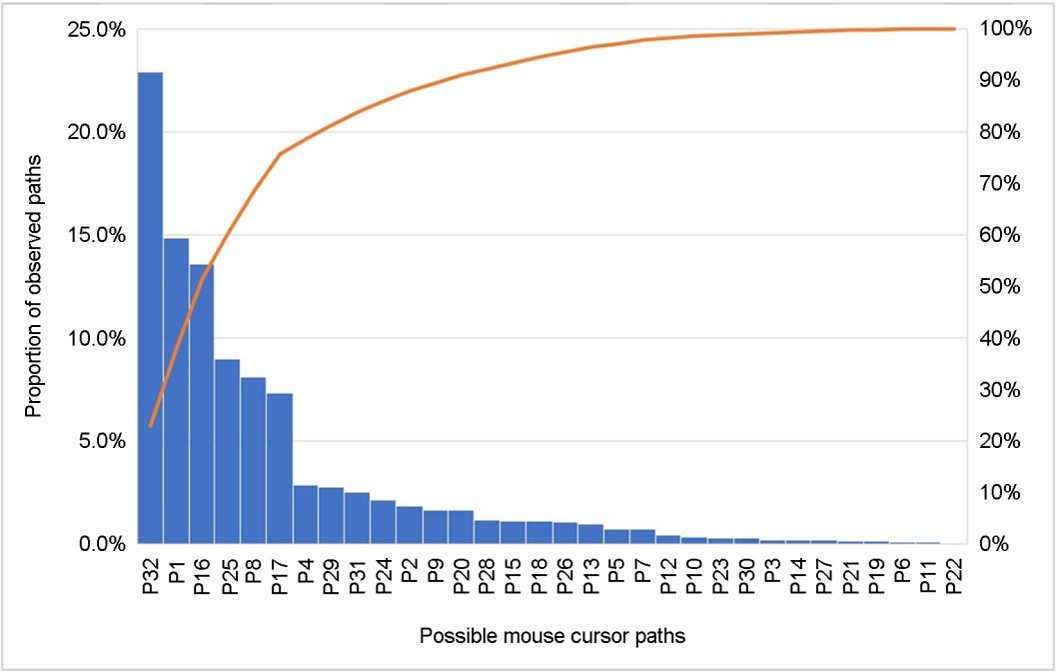
피실험자들의 선호하는 마우스 커서 이동 경로는 6가지 경로였다. 경로 32는 22.9%, 경로 1은 14.8%, 경로 16은 13.6%, 경로 25는 9.0%, 경로 8은 8.1%, 경로 17은 7.3%였다. 누적된 퍼센트는 75.8%였다. 다른 경로들은 2.9% 이하였다. Figure 4는 가능한 경로와 피실험자들이 수행한 경로에 대한 파레토 분석의 결과다. 결과적으로 가능한 마우스 커서 이동 경로는 다양하지만, 작업자들은 일부 경로만을 사용하고 있다는 것을 알 수 있다. 그리고 비교적 단순한 경로를 선택하고 있다. Figure 5는 선호되는 6개의 경로를 나타낸다.
3.3 Relationship between mouse cursor trajectory and movement time
어떤 실험 조건에서 어떤 마우스 이동 경로를 더 선호하는지 분석하였다. Table 2는 각 경로의 선택에 영향을 미치는 실험 조건을 정리한 것이다. 분석결과, 이동 경로의 선택에 있어 표적의 이동 속도가 가장 중요한 요인으로 나타났다. 표적이 고정되어 있을 때 선호되는 이동 경로는 경로 1, 17, 25였다. 이 3가지 경로의 공통점은 표적에 접근하는 후반 단계(3, 4, 5단계)에서 마우스 커서가 직선의 상단에 위치한다는 점이다. 반면에 움직이는 표적을 포인팅할 때 선호되는 이동 경로는 경로 8, 16 32로 나타났다. 이들 경로는 고정 표적의 경우와 상반되게, 표적에 접근하는 단계(3, 4, 5단계)에서 마우스 커서가 직선의 하단에 위치하는 특성을 보였다. 한편 표적의 너비(W)와 표적까지의 이동 거리(A) 역시 특정 이동 경로의 선택에 일부 영향을 주었으나, 표적의 이동 속도에 비해 그 영향력이 상대적으로 미미하였으며, 일관된 경향을 나타내지 않았다.
|
Main paths |
Patterns |
Predominant experimental conditions |
|
Path 1 |
UP-UP-UP-UP-UP |
Higher preference at lower
target velocities (F(2, 8) = 45.31,
p < .001) |
|
Higher preference for wider
target widths (F(2, 8) = 6.67, p < 0.05) |
||
|
Path 8 |
UP-UP-DN-DN-DN |
Higher preference at higher
target velocities (F(2, 8) = 43.15, p < 0.001) |
|
Higher preference for longer
target distance (F(2, 8) = 14.37, p < 0.01) |
||
|
Path 16 |
UP-DN-DN-DN-DN |
Higher preference at higher
target velocities (F(2, 8) = 83.59, p < 0.001) |
|
Path 17 |
DN-UP-UP-UP-UP |
Higher preference at lower
target velocities (F(2, 8) = 67.2, p < 0.001) |
|
Higher preference for longer
target distance (F(2, 8) = 13.52, p < 0.01) |
||
|
Path 25 |
DN-DN-UP-UP-UP |
Higher preference at lower
target velocities (F(2, 8) = 98.42,
p < 0.001) |
|
Path 32 |
DN-DN-DN-DN-DN |
Higher preference at higher
target velocities (F(2, 8) = 34.62, p < 0.001) |
|
Higher preference for shorter
target distance (F(2, 8) = 8.07, p < 0.05) |
본 연구에서는 2차원 공간에서 일정한 속도로 원형 궤도를 따라 시계 방향으로 이동하는 표적을 대상으로, 마우스 포인팅 작업 시 발생하는 커서의 이동 경로를 측정하고 분석하였다. 아울러 이와 비교하기 위해 고정된 표적을 포인팅하는 작업에서의 마우스 커서 이동 경로 역시 함께 측정하여 비교 분석을 수행하였다.
분석결과, 마우스 커서의 이동 경로는 고정 표적과 이동 표적 간에 명확한 차이를 보였다. 마우스 커서의 이동 시작 시점부터 표적 클릭 시점까지의 구간을 5단계로 구분하고, 각 단계에서 커서가 시작점과 종점을 잇는 직선의 상단과 하단 중 어디에 위치하는지 분석하였다. 고정 표적을 포인팅할 때는 1 · 2단계에서 직선의 하단에, 3 · 4 · 5단계에서는 상단에 커서가 위치하였다. 반면, 이동 표적을 포인팅할 때는 이와 반대로 1 · 2단계에서 직선의 상단에, 3 · 4 · 5단계에서는 하단에 커서가 위치하는 경향을 보였다. 이러한 경향성은 표적의 이동 속도가 증가할수록 더욱 뚜렷하게 나타났다.
이동 표적 포인팅 시 나타난 마우스 커서의 이동 경로는 피실험자가 표적의 이동 방향을 미리 예측하고 행동한 결과로 추정된다. Peterken 등 (1991)은 일정한 속도로 이동하던 표적이 화면 중간에서 사라지는 환경에서 포인팅 실험을 실시하였으며, 표적이 사라지는 시간이 짧은 경우에는 포인팅 수행도에 유의미한 영향을 미치지 않음을 확인하였다. 본 연구에서도 피실험자들은 이동 표적의 이동 방향을 사전 예측하여 마우스 커서를 이동시키는 경향을 보였다. 즉, 움직이는 표적의 위치를 미리 예측하고 표적의 진행 방향 아래쪽으로 커서를 이동시켰기 때문에, 후반부인 4 · 5단계에서 직선 하단에 커서가 위치하는 경향이 강하게 나타난 것으로 판단된다.
표적 포인팅을 위해 선택 가능한 마우스 커서의 이동 경로는 총 32가지였으나, 피실험자들이 실제로 선택한 경로는 매우 제한적이었다. 상위 6가지 경로가 전체의 75.8%를 차지하였으며, 이들 경로는 복잡하지 않고 직관적이며 단순한 형태였다. 예컨대 처음부터 끝까지 직선의 상단 또는 하단으로만 이동하거나, 상 · 하단을 교차하더라도 단 1회만 교차하는 경로들이었다. 이러한 경로 선택 경향은 Fitts (1954)가 지적한 바와 같이, 이동시간을 최소화하는 과정에서 피실험자들이 복잡한 경로를 지양하고 효율적인 경로를 선택한 결과로 풀이된다. 한편, 이동 표적 포인팅 시에는 하단-하단-하단-하단-하단(Path 32, 22.9%), 상단-하단-하단-하단-하단(Path 16, 13.6%), 상단-상단-하단-하단-하단(Path 8, 8.1%) 순으로 선호되었다. 반면 고정 표적의 경우에는 상단-상단-상단-상단-상단(Path 1, 14.8%), 하단-하단-상단-상단-상단(Path 25, 9.0%), 하단-상단-상단-상단-상단(Path 17, 7.4%) 순으로 선호도가 높았다.
결론적으로, 고정 표적 포인팅 작업과 이동 표적 포인팅 작업 간에는 마우스 커서의 이동 경로에 분명한 상이성이 존재한다. 이러한 커서 이동 경로의 차이는 궁극적으로 포인팅 시간에도 영향을 미칠 것이다. 따라서 포인팅 시간을 설명하고 예측하는 Fitts 모델을 제안할 때는 이러한 이동 경로의 차이를 반드시 반영해야 한다. 즉, 전통적인 Fitts 법칙을 수정하여 이동 표적에 적용 가능한 모델을 고안할 때 커서 이동 경로의 변수를 통합하는 모델 제안이 요구된다.
본 연구는 이동 표적의 이동 방향을 원형 궤도로 한정하여 수행되었다. 기존 연구들 역시 2차원 환경에서 원형 궤도를 따라 이동하는 표적을 주로 다루어 왔다(Lee and Hong, 2022; Zheng et al., 2025). 그러나 실제 환경에서는 표적이 일정한 궤도를 벗어나 더 다양하고 복잡하게 이동 방향을 전환하는 경우가 발생할 수 있다. 따라서 본 연구결과를 더욱 일반화하기 위해서는 향후 다양한 패턴으로 움직이는 표적을 대상으로 한 추가적인 실험과 검증이 필요하며, 피실험자 성별에 따라 연구결과의 차이가 나타날 수 있기 때문에 성비의 균형을 고려한 추가 연구가 필요하다.
References
1. Accot, J. and Zhai, S., Beyond Fitts' law: Models for trajectory-based HCI tasks. Proceedings of the ACM SIGCHI Conference on Human Factors in Computing Systems, 295-302, 1997. https://doi.org/10.1145/258549.258760
Google Scholar
2. Baird, K.M., Hoffmann, E.R. and Drury, C.G., The effects of probe length on Fitts' law. Applied Ergonomics, 33(1), 9-14, 2002.
Google Scholar
3. Chan, A.H., Hoffmann, E.R. and Wong, K.P., Seated leg/foot ballistic and visually-controlled movements. International Journal of Industrial Ergonomics, 56, 25-31, 2016.
Google Scholar
4. Fitts, P.M., The information capacity of the human motor system in controlling the amplitude of movement. Journal of Experimental Psychology, 47(6), 381, 1954.
Google Scholar
5. Hoffmann, E.R., Capture of moving targets: A modification of Fitts' Law. Ergonomics, 34(2), 211-220, 1991. https://doi.org/ 10.1080/00140139108967307
Google Scholar
6. Hoffmann, E.R., Fitts' Law With An Average of Two or Less Submoves? Journal of Motor Behavior, 48(4), 318-331, 2016. https://doi.org/10.1080/00222895.2015.1092939
Google Scholar
7. Huang, J., Tian, F., Li, N. and Fan, X., Modeling the Uncertainty in 2D Moving Target Selection. Proceedings of the 32nd Annual ACM Symposium on User Interface Software and Technology, 1031-1043, 2019. https://doi.org/10.1145/3332165.3347880
Google Scholar
8. Jagacinski, R.J., Repperger, D.W., Moran, M.S., Ward, S.L. and Glass, B., Fitts' law and the microstructure of rapid discrete movements. Journal of Experimental Psychology: Human Perception and Performance, 6(2), 309, 1980.
Google Scholar
9. Lee, J. and Hong, S.K., Time to capture a moving target travelling along a circular trajectory. Applied Sciences, 12(4), 1911, 2022.
Google Scholar
10. MacKenzie, I.S., Fitts' Law as a Research and Design Tool in Human-Computer Interaction. Human–Computer Interaction, 7(1), 91-139, 1992. https://doi.org/10.1207/s15327051hci0701_3
Google Scholar
11. Murata, A., Doi, T. and Karwowski, W., Prediction model of pointing time by a mouse based on characteristics of cursor movement trajectory. Theoretical Issues in Ergonomics Science, 26(6), 732-749, 2025. https://doi.org/10.1080/1463922X.2025.2522417
Google Scholar
12. Peterken, C., Brown, B. and Bowman, K., Predicting the future position of a moving target. Perception, 20(1), 5-16, 1991. https://doi.org/10.1068/p200005
Google Scholar
13. Zheng, Y., Huang, J., Zhang, H., Bian, Y., Liu, J., Yang, C., Tian, F. and Meng, X., 3D Ternary-Gaussian model: Modeling pointing uncertainty of 3D moving target selection in virtual reality. International Journal of Human-Computer Studies, 198, 103454, 2025.
PIDS App ServiceClick here!
